Charlottenburg Town Hall, Town hall in Charlottenburg-Wilmersdorf, Berlin, Germany
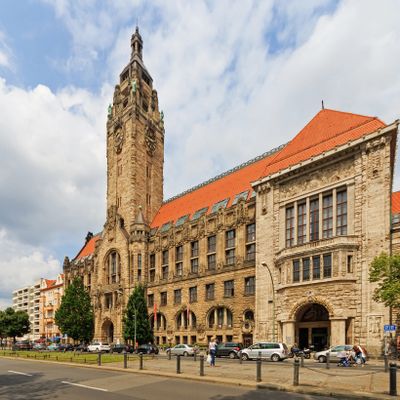
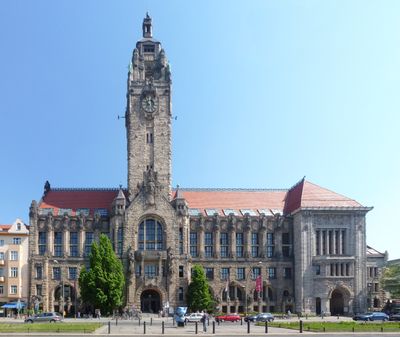
Charlottenburg Town Hall is a monumental civic building on Otto-Suhr-Allee, erected between 1899 and 1905 to designs by Heinrich Reinhardt and Georg Süßenguth. Its 70-metre sandstone facade faces the street, and the main portal grille shows Jugendstil forms. The 88-metre tower rises above the complex, which was extended eastward by Heinrich Seeling in 1911–1916.
Charlottenburg received town privileges on 5 April 1705, and its first town hall opened that year in a palace on Schloßstraße; the king himself served as mayor. A second hall was inaugurated on the road to Berlin on 5 December 1860. The present building, designed by Heinrich Reinhardt and Georg Süßenguth, was inaugurated on 20 May 1905 for the town's 200th anniversary, with an eastern annex by Heinrich Seeling added in 1910–1916. An RAF air raid on the night of 22 November 1943 severely damaged it, and West Berlin authorities rebuilt it gradually into the 1960s.
The main portal grille shows Jugendstil forms, and maxims for successful living were placed throughout the building. The 88-metre tower deliberately exceeded the dome of Charlottenburg Palace, which allegedly caused trouble with Emperor Wilhelm II. The sandstone facade is 70 metres long.
The main portal on Otto-Suhr-Allee 100 is set in a tan stone arch with a dark metal grille and a transom window bearing the number 100. The building stands beside Richard-Wagner-Platz, and the entrance to the community library is on the eastern part of the facade.
The 88-metre tower was built taller than the dome of nearby Charlottenburg Palace, which allegedly caused trouble with Emperor Wilhelm II. The main portal grille shows Jugendstil forms, and the 70-metre sandstone façade was designed by Heinrich Reinhardt and Georg Süßenguth.
The community of curious travelers
AroundUs brings together thousands of curated places, local tips, and hidden gems, enriched daily by 92,805 contributors worldwide.