Brennender Berg, Natural monument in Saarbrücken, Germany
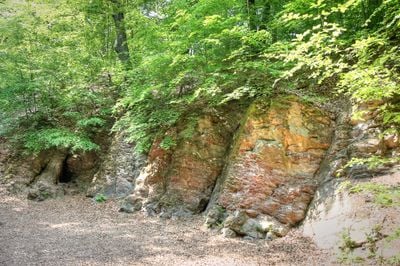
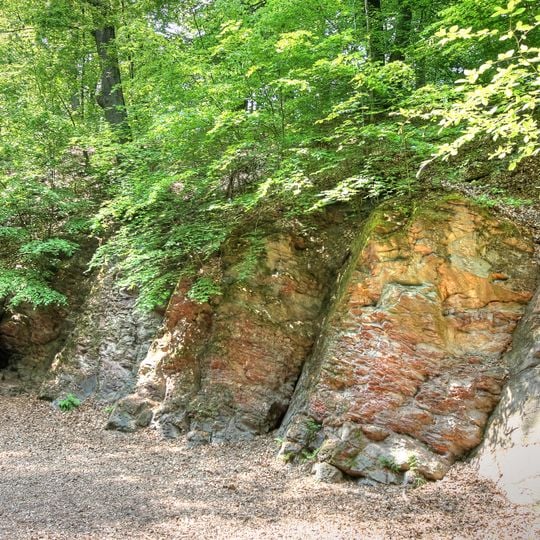
Brennender Berg is a natural monument near Saarbrücken marked by an underground coal fire that has been active for centuries. The landscape shows cracks and warm patches where the hidden fire reaches toward the surface.
The coal seam caught fire in the 1660s, probably through spontaneous combustion caused by pressure and decomposition from unplanned coal mining; a shepherd's fire at a tree stump is the legendary cause. Attempts to extinguish it with water failed. By the end of the 18th century the fire had weakened, and the 1810 Duhamel atlas marked two spots, one almost extinct. Goethe visited in July 1770.
The name means "Burning Mountain", and the fire is not a flame but a glow inside the rock. Goethe came here in July 1770 and later described reddish, white-roasted rock, dense steam from the crevices and hot ground felt through thick shoe soles; a commemorative plaque marks the visit.
The natural monument lies in a narrow gorge about 500 m north-northwest of the unnamed summit, between Dudweiler and Neuweiler. From the end of Brennender-Berg-Straße in Neuweiler, a slightly descending forest path marked with an upright green diamond leads roughly 800 m to the site. Another starting point is the ASC Dudweiler car park on Am Gegenortschacht. The ground is uneven and the path narrow.
The fire does not burn with an open flame; it glows, and in the 18th century that glow could be seen through cracks in the rock. Today, depending on the weather, smoke rises and at least one rock crevice releases warm air. Goethe visited in July 1770 and felt the hot ground through thick shoe soles.
The community of curious travelers
AroundUs brings together thousands of curated places, local tips, and hidden gems, enriched daily by 92,784 contributors worldwide.