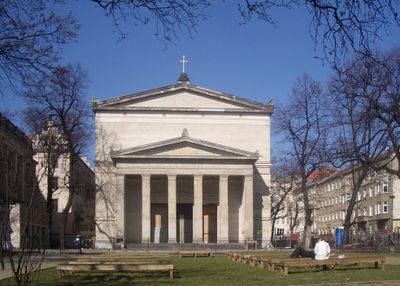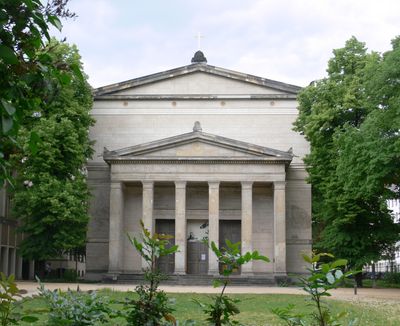
Elisabethkirche, Berlin-Mitte, Neoclassical church in Mitte, Germany.
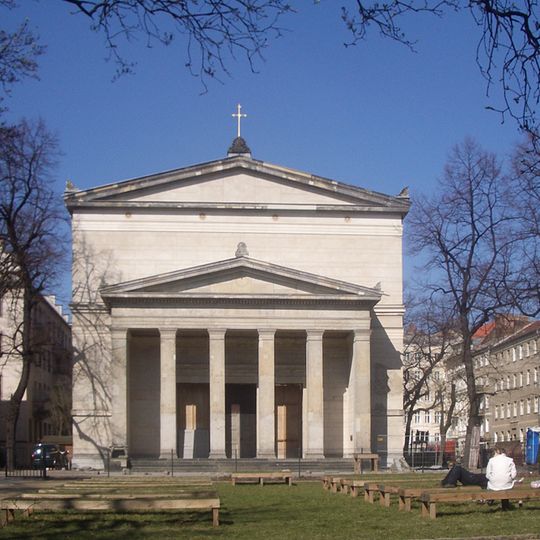
Elisabethkirche is a neoclassical church building in Mitte characterized by a spacious hall with classical columns and symmetrical design. The interior spans a large room that can accommodate groups of different sizes and is structured to support both performances and cultural gatherings.
Karl Friedrich Schinkel designed the Elisabethkirche in 1828 on behalf of King Friedrich Wilhelm III, and it was built from 1832 to 1834, consecrated on 28 June 1835. Crown Princess Elisabeth attended the ceremony, likely influencing the name. Phosphor bombs hit the church on the night of 8–9 March 1945, burning out the wooden interior; it stayed a ruin until restoration from 1990 to 2001.
Since the restoration the Sophiengemeinde runs the building with the Berlin Senate's culture department, staging Early and Contemporary Music, theatre, exhibitions of current art and experimental projects mixing genres. The name refers to Princess Elisabeth, who attended the consecration on 28 June 1835. A new church organ is not planned.
The church stands at Invalidenstraße 3/4a, facing the street with its six-column portico; the surrounding park, laid out by Hermann Mächtig in 1881 and reworked by 2001, has benches. The interior is a single hall of 28 by 18 metres, so sightlines are open from every seat. The flanking doorways are boarded, and the central grey door with its small sign is the way in.
The church has no visible bell tower, yet it received a three-note peal of cast-steel bells made at the Bochumer Verein in the late 19th century; the congregation paid 1,814 marks for bells, clappers, axles, bearings and levers. Because they were not bronze, they were not requisitioned during the Second World War.
The community of curious travelers
AroundUs brings together thousands of curated places, local tips, and hidden gems, enriched daily by 94,640 contributors worldwide.