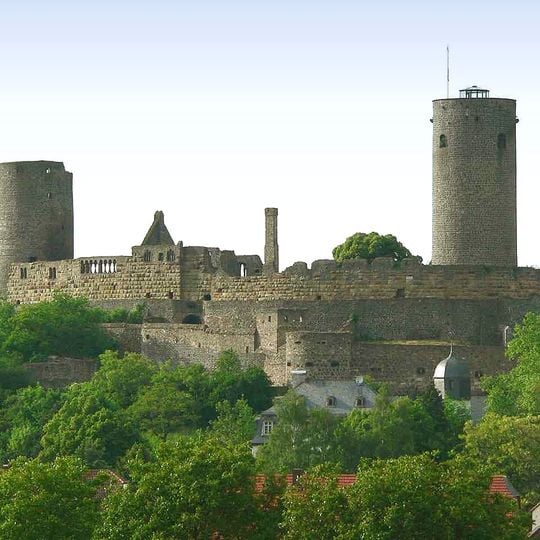
Münzenberg Castle, Medieval fortress in Wetteraukreis, Germany
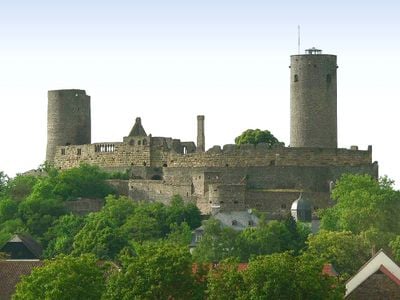
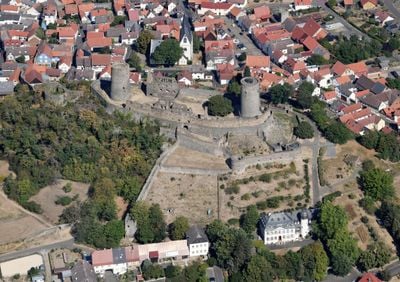
Münzenberg Castle is a medieval fortress built on a hilltop with two round towers rising about 29 meters high and thick walls enclosing an inner courtyard. Beyond the defensive towers, the site includes remains of residential buildings and casemates that show the complexity of this fortification.
Kuno I von Münzenberg, chamberlain of Emperor Frederick Barbarossa, built the castle from the 1150s; it was first mentioned in a 1162 charter. Around 1260 the Falkensteins added the northern palace and a second keep. The Solms family modernized it in 1514 with battery towers, but the Thirty Years' War left it in ruins. Restoration began in 1846, and the state acquired it in 1935.
The castle is also called the Wetterau Inkwell (Wetterauer Tintenfass) because its two round towers resemble an inkwell. The name Münzenberg means "mint mountain", after the mint that grew on the hill. The counts of Solms-Lich altered the Romanesque palace in late Gothic style from 1514, adding a large western battery tower and four smaller ones to the outer wall.
Visitors can explore the fortress on marked paths and climb both towers as well as walk along the fortification walls. Sturdy footwear is recommended since the terrain is hilly and some areas are uneven.
The two round bergfrieds stand at opposite ends of the inner ward, the taller one reaching 29 metres. Most castles in the region have only a single such tower as their strongest point, so the pair at Münzenberg is a deliberate doubling of the main strongpoint. The inner ward is ringed by an outer ward and curtain wall, giving defence in depth.
The community of curious travelers
AroundUs brings together thousands of curated places, local tips, and hidden gems, enriched daily by 93,842 contributors worldwide.