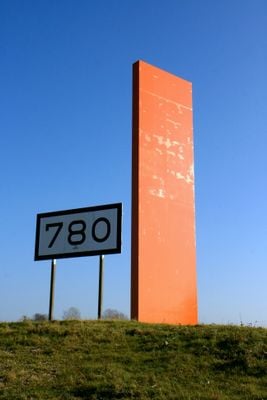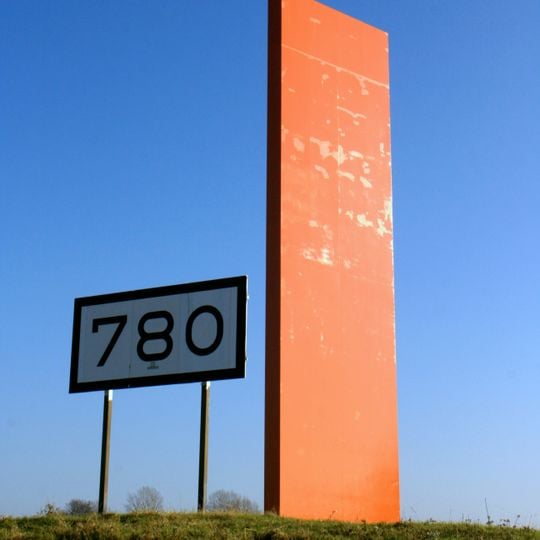
Rhine Orange, Steel sculpture at Rhine-Ruhr confluence, Duisburg, Germany.
Rhine Orange is a flat, vertical steel monolith at the mouth of the Ruhr in Duisburg, 25 metres tall, 7 metres wide and 1 metre thick. Its front face is painted orange-red (RAL 2004) and shows weathered, flaking patches. A white sign on two posts nearby reads "780", marking the Rhine kilometre.
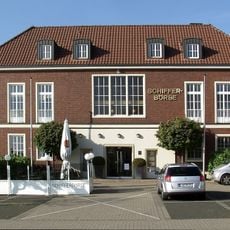
The steel sculpture was erected in 1992 at the mouth of the Ruhr, at Rhine kilometre 780. It was made by Cologne sculptor Lutz Fritsch and financed with over 400,000 DM donated by companies after a fundraising initiative by the Wirtschaftsjunioren of the Niederrhein IHK. The Lehmbruck Museum was not involved in its creation; the museum is only cited among the aspects of Duisburg life the landmark is meant to represent.
The name is a pun: Rheinorange sounds like Reinorange, the RAL 2004 pure-orange tone of the paint. The glowing red slab recalls a steel ingot, a nod to Ruhr steelmaking. The sculpture marks the end of the 230 km Ruhrtalradweg and of the Tortour de Ruhr, run as Germany's longest ultramarathon until 2026.
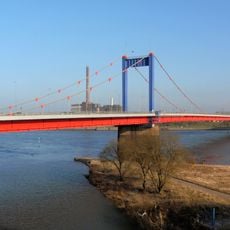
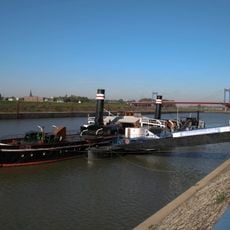
The artwork stands directly on the riverbank and is easily accessible on foot or by bicycle, especially for cyclists on the Ruhr cycle trail. The location works well for pausing to look around and offers good views of both rivers and the surrounding port and industrial landscape.
The artwork took its name from combining the river name Rhine with the specific color orange, defined by the industrial color standard RAL 2004. This naming choice symbolically links the geographic location with a precise technical detail that connects to Duisburg's engineering and manufacturing traditions.
The community of curious travelers
AroundUs brings together thousands of curated places, local tips, and hidden gems, enriched daily by 93,612 contributors worldwide.