Michaelsberg Abbey, Siegburg, Benedictine abbey on Michaelsberg hill in Siegburg, Germany
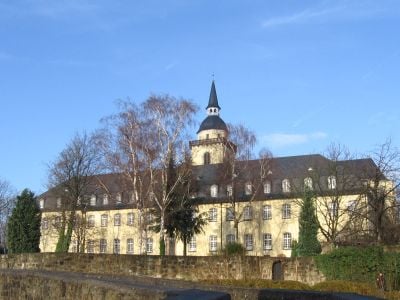
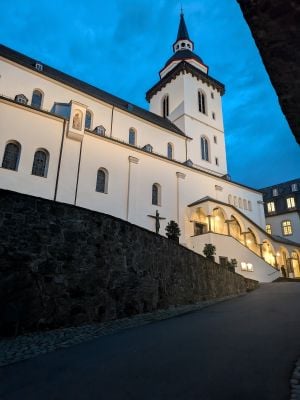
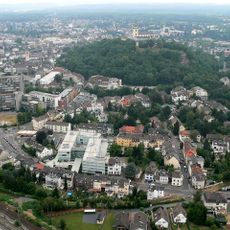
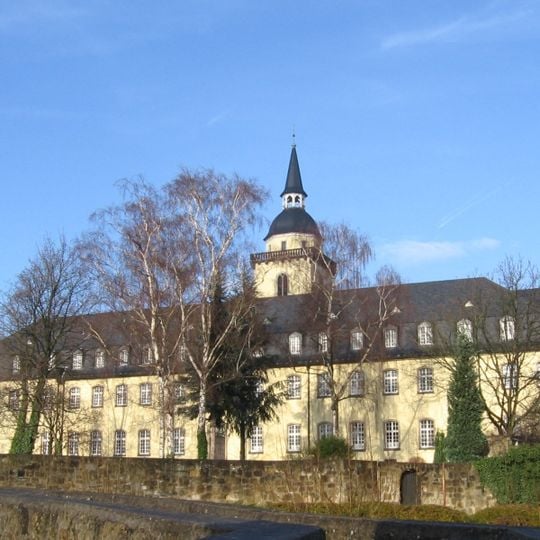
Michaelsberg Abbey stands on the Michaelsberg, about 40 metres above Siegburg. The long, pale yellow monastery building has a steep dark roof, rows of white-framed windows and a central square tower with a domed cupola and slender spire. A low wall of rough grey-brown stone runs along its base. The abbey church, rebuilt with Baroque elements between 1649 and 1667, adjoins the complex.
Archbishop Anno II of Cologne founded the Benedictine abbey in 1064 and was buried there after his death in 1075; his remains were translated into the Annoschrein in 1183. The abbey was suppressed on 12 September 1803 during secularisation and later served as a lunatic asylum and a prison. In 1914 Benedictine monks from Merkelbeek in the Netherlands resettled it, and the community closed again in 2011.
The abbey and the hill both take their name from the Archangel Michael, to whom Anno II dedicated the monastery in 1064. Since 1504 the monks' liqueur, Siegburger Abtei-Likör, has been documented here; production resumed in 1952 and continued until the abbey closed in 2011. The Annoschrein, holding the relics of the founder canonised in 1183, can still be seen in the abbey church.
The church within the complex is open to visitors during daylight hours, with times varying by season. A walking path from the town center leads uphill to the site, so comfortable shoes are useful for the elevation change.
Archbishop Anno II died at the abbey in 1075 and was buried here; after his canonisation on 29 April 1183 his remains were moved into the Annoschrein, a shrine still kept in the abbey church. The abbey liqueur was first documented in 1504, resumed in 1952, and from 2004 a beer called Michel was brewed; both ended with the closure in 2011.
The community of curious travelers
AroundUs brings together thousands of curated places, local tips, and hidden gems, enriched daily by 92,873 contributors worldwide.