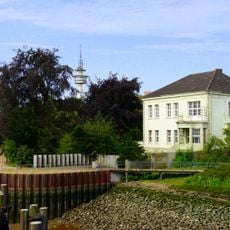
Alte Geestebrücke, Road bridge in Geestemünde, Germany
The Alte Geestebrücke is a steel swing bridge built in 1904 at Fährstraße in Bremerhaven-Geestemünde, carrying two vehicle lanes and two pedestrian walkways outside the truss structure across the Geeste. Its non-parallel-chord truss links a lower chord to an upper chord up to about seven metres above it through vertical and diagonal lattice girders, forming a lattice bridge; crosswise, girders and diagonal bracing span the deck. The northwest steel portal bears two Bremen coats of arms, the state arms and the former city arms of Bremerhaven, flanked by depictions of the Roter Sand lighthouse and a North German Lloyd steamship.
A two-leaf swing bridge with a 56-foot (16.36 m) clear span was built by the Kingdom of Hannover from 1856 to 8 January 1857, replacing a Prahm ferry that could no longer handle traffic. The present bridge, a steel lattice truss, was built in 1904 to plans by Regierungsbaumeister Schubert for the Wasserbauinspektion Geestemünde by the firm M. Achgelis Söhne. It has been a listed monument since 1978.
The northwest portal displays two Bremen coats of arms representing the city's identity and history. Beside them are images of the Roter Sand lighthouse and a North German Lloyd steamship, reflecting the maritime heritage of this area.
The bridge carries two vehicle lanes and two pedestrian walkways set outside the steel truss, linking Geestemünde with Bremerhaven-Mitte. Bus lines 502, 504, 505 and 506 plus the night lines ML and NL cross it; other services use the parallel Kennedybrücke. The Busse monument by Fritz Höger stands at the bridge.
The Busse monument beside the bridge was built in 1936 to a design by Hamburg architect Fritz Höger in late brick expressionism. It marks the 1885 commissioning of the fishing steamer Sagitta by shipowner Friedrich Busse.
The community of curious travelers
AroundUs brings together thousands of curated places, local tips, and hidden gems, enriched daily by 94,558 contributors worldwide.