Eilvese transmitter, Radio transmitter station in Neustadt am Rübenberge, Germany
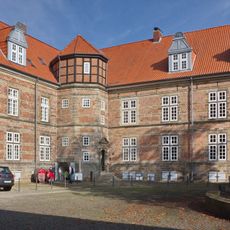
Eilvese transmitter was a long-distance radiotelegraphy station in the Totes Moor south of Eilvese. Its central steel lattice mast, 260 metres tall and split by glass insulators at 145 metres, was Germany's tallest structure when completed in 1913. Around it stood six wooden masts carrying umbrella and ring antennas. Only the office and administration building survives, now a dwelling, with remnants of the operating building and mast foundations nearby.
Built between 1911 and 1913, the facility had a 260-meter main transmission mast that was Germany's tallest structure of that era. The mast was demolished in 1931, yet the site remains a landmark of early radio broadcasting development.
On 19 June 1914 Kaiser Wilhelm II opened the station in person, sending a telegram to US President Woodrow Wilson that was received at Tuckerton, New Jersey. The first contact between the two stations had already been made on 14 October 1913. Until 1931 the transmitter mostly carried press telegrams, since private telegrams went through the Nauen station near Berlin.
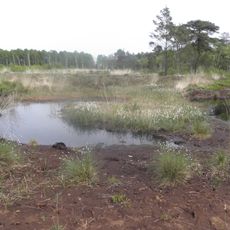
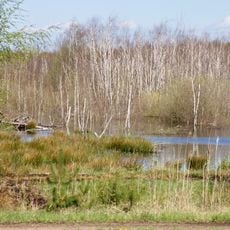
The site lies within a bog landscape and is best reached on foot or by bicycle. The area is open and sparsely developed, so proper footwear and weather protection are advisable for a visit.
When peat was cut after 1931, the 250-metre central mast was simply left to fall into the bog, so insulators and antenna fragments still turn up during peat digging. The site was chosen because it lay far enough from the stations at Norddeich and Borkum to avoid interference.
The community of curious travelers
AroundUs brings together thousands of curated places, local tips, and hidden gems, enriched daily by 94,254 contributors worldwide.