Angermünde railway station, Railway station in Angermünde, Germany.
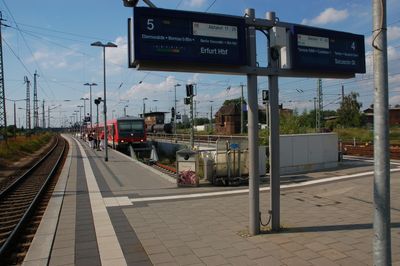
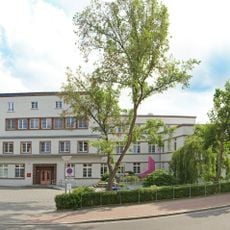
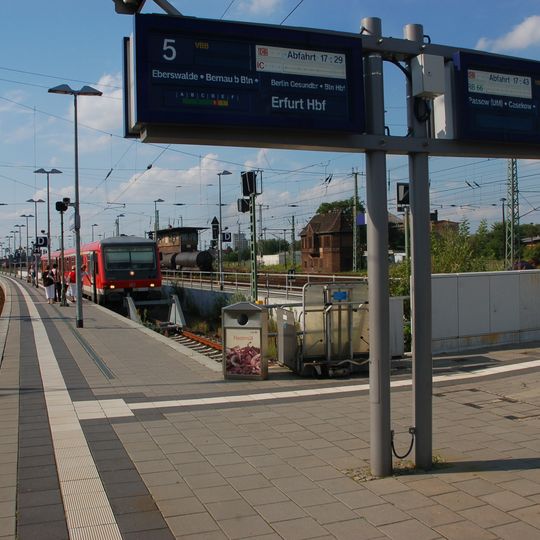
Angermünde railway station is a listed station building in the Brandenburg town of Angermünde, served by both regional and long-distance trains. The station has two island platforms and four passenger tracks, with an extra terminal track at the northern end of the facility.
The station opened on November 15, 1842 as part of the new Berlin to Stettin railway line, one of the first long-distance rail connections in the region. This route placed Angermünde at a key point between the Prussian capital and the Baltic coast, a role it has kept ever since.
The station was designed by architect Friedrich Neuhaus and displays the classical building style of the 19th century, with a symmetrical facade and carefully worked stone details. Visitors who enter the main hall can still see how the building was meant to convey order and solidity, which was typical of public structures of that era.
The station has elevators that make it easier to reach the platforms with heavy luggage or a stroller, and there is bicycle storage near the entrance. Outside the building, taxis wait at a dedicated stand and car parking is available close by.
When it opened in 1842, the Berlin to Stettin line was one of the earliest long-distance railways on what is now German territory, and Angermünde was among the very first stops. At the time, most people in the region had never seen a train before, making the station one of the few places in Brandenburg where this new form of transport could be experienced firsthand.
The community of curious travelers
AroundUs brings together thousands of curated places, local tips, and hidden gems, enriched daily by 91,185 contributors worldwide.