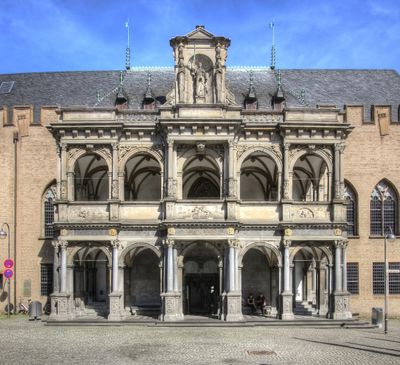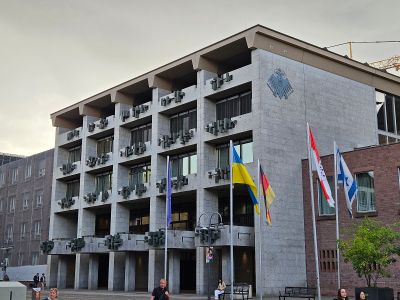
Cologne City Hall, Renaissance town hall in Altstadt-Nord, Germany.
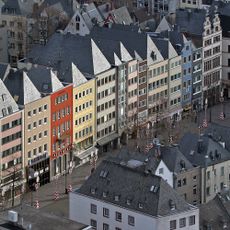
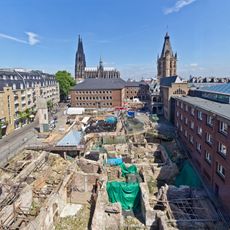
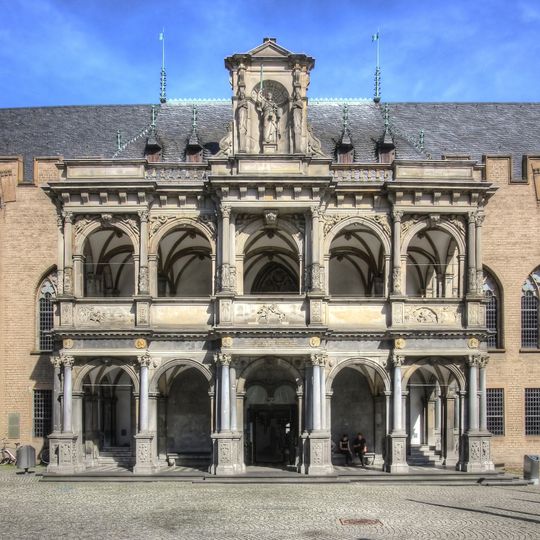
Cologne City Hall is an administrative building in Altstadt-Nord, Germany, featuring detailed stonework and a multi-story facade. The structure displays decorative arches, towers, and numerous sculptures distributed across the exterior surface.
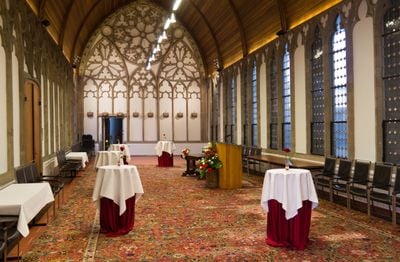
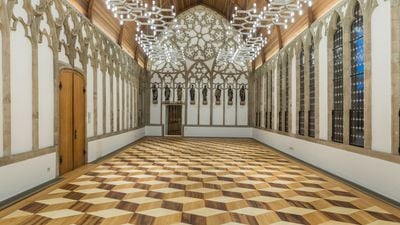
The oldest surviving part is the Gothic Saalbau of around 1330, whose Hansasaal hosted a Hanseatic League assembly on 19 November 1367. The council commissioned the 61-metre Ratsturm on 19 August 1406; it was built from 1407 to 1414 to store documents and privileges. The Renaissance loggia by Wilhelm Vernukken followed in 1569–1573, and the Spanischer Bau in 1660/61.
The tower's carillon, installed in 1958, plays from 45 bronze bells donated by Cologne's craft guilds, joined by two bells from associations and the largest donated by Konrad Adenauer. Every day at 9, 12, 15 and 18 o'clock it sounds one of 24 programmed melodies; at noon, Karlheinz Stockhausen's twelve zodiac melodies are played. On the hour, the Platzjabbeck, a 15th-century head under the tower clock, sticks out its tongue toward the Alter Markt.
The complex sits between Rathausplatz and Alter Markt, a short walk from Hohe Straße in the Innenstadt. The carillon in the tower plays at 9, 12, 15 and 18 o'clock, with Stockhausen's zodiac melodies at noon. The Platzjabbeck figure on the tower's east side sticks out its tongue on the hour.
Beneath the statue of Konrad von Hochstaden on the tower, a small carved male figure performs an obscene act, a grotesque that has survived the tower's restorations. On the hour, a mechanical head called the Platzjabbeck leans out from the east side and sticks out its tongue toward the Alter Markt.
The community of curious travelers
AroundUs brings together thousands of curated places, local tips, and hidden gems, enriched daily by 92,788 contributors worldwide.