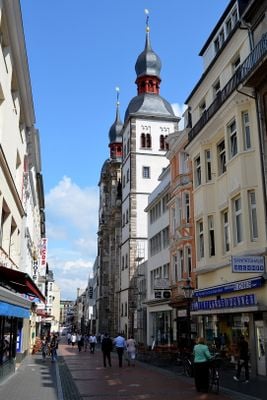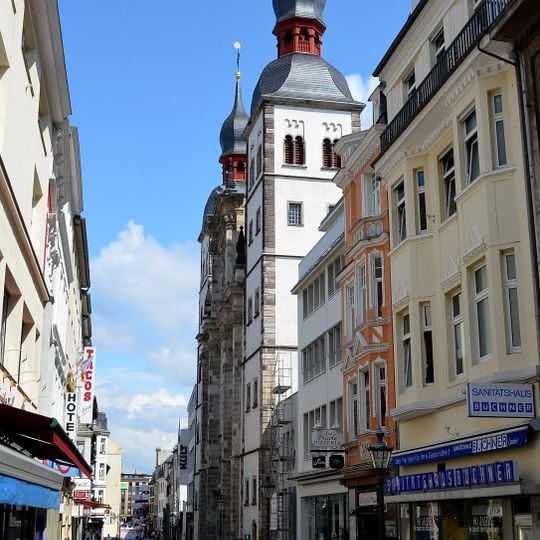
Holy Name Church, Jesuit church in Bonn-Zentrum, Germany.
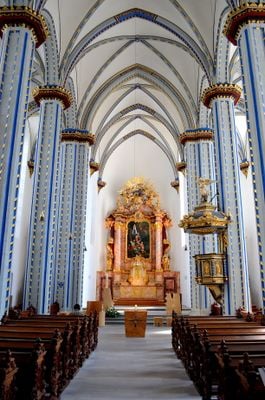
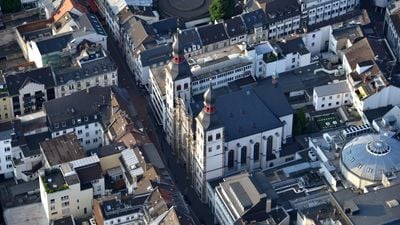
The Holy Name Church is a post-Gothic Jesuit church on Bonngasse, built from 1686 to 1717 to plans by Giacomo de Candrea. Its two towers, about 53 metres tall, carry Romanesque double windows, pointed Gothic windows and baroque columns, each crowned by a Welsche Haube. The interior, 33.5 metres long with a 16-metre nave, reads as a hall church; the high altar by Bartholomäus Dierix dates from around 1755.
The foundation stone was laid on 14 September 1686 under Archbishop Maximilian Heinrich of Bavaria, after a piece of beech wood bearing the name of Jesus (IHS) was found. The church was badly damaged in the 1689 bombardment during the War of the Palatine Succession, and the Jesuits were expelled that year. Work resumed around 1692; the church was entered on 3 December 1694 and completed in 1698. It was consecrated in 1717 by Elector Joseph Clemens.
The name refers to the Feast of the Holy Name of Jesus, added to the Latin liturgical calendar in 1721 by Pope Innocent XIII at the request of Emperor Charles VI. Since 2012 the church has served the Old Catholic Church in Germany as its cathedral and city church, and the Namen-Jesu-Kirche foundation also hosts concerts and exhibitions alongside the liturgy.
The church sits in the center of Bonn and is easily accessible on foot. Visitors should be aware that religious services occur at set times and access may be limited during these periods.
Under the altar area a barrel vault holds the graves of 66 Jesuit priests from the monastery period up to 1774. The Old Catholic Church has since turned this crypt into a columbarium open to anyone connected with the church; the academic Ulrich Heifer (1930–2018) is buried here.
The community of curious travelers
AroundUs brings together thousands of curated places, local tips, and hidden gems, enriched daily by 94,542 contributors worldwide.