Schloss vor Husum, Renaissance castle and cultural center in Husum, Germany.
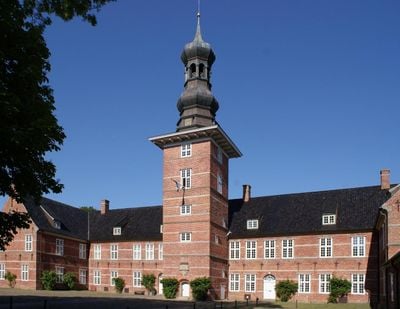
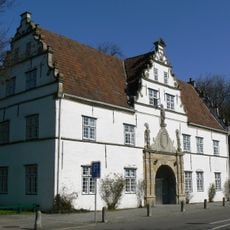
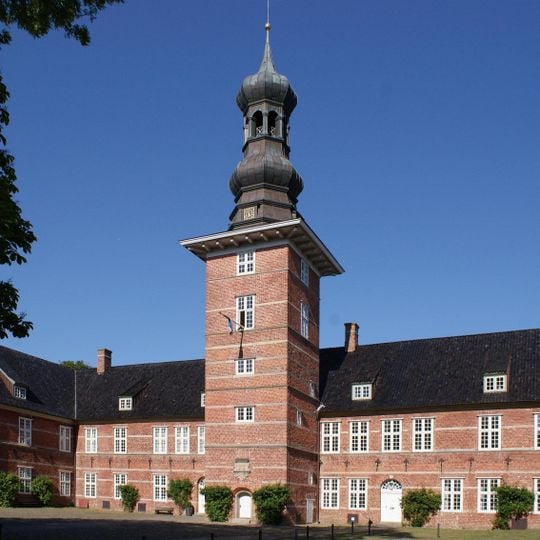
Schloss vor Husum is a three-winged red-brick castle built in Northern Renaissance style, with a central tower rising in stacked tiers to a dark multi-tiered cupola and slender spire. The facade has rows of tall rectangular windows with light frames, horizontal stone bands crossing the tower sections, and a stepped-gable doorway at its base. Low bushes line the ground floor.
Duke Adolf of Schleswig-Holstein-Gottorf had the castle built from 1577 to 1582 on the site of the Grey Monastery, whose Franciscan friars left in 1527. It served as a secondary residence for the Gottorf court on the west coast, while Gottorf near Schleswig remained the seat of government. From 1610 Duchess Augusta, widow of Johann Adolf, lived here regularly and brought artists to the court; Maria Elisabeth, widow of Friedrich III, resided here from 1660 to 1684. After 1721 the castle passed to the Danish crown, and Otto Johann Müller renewed the dilapidated building in reduced form between 1750 and 1752.
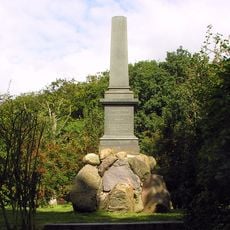
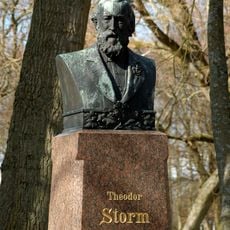
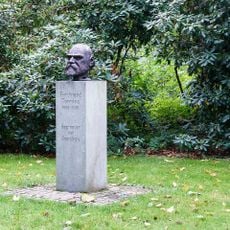
The name "vor Husum" (before Husum) dates from the 19th century, when the castle still stood outside the town boundary. Duchess Augusta, daughter of Frederick II of Denmark, made the house a centre for artists and died there on 5 February 1639. In the castle park stands a memorial to the poet Theodor Storm by Husum sculptor Adolf Brütt.
The castle museum and cultural centre are open to the public; the castle park is freely accessible and known for its crocus bloom in spring. The site lies just outside Husum's old town, within walking distance of the harbour. Parts of the building are only accessible to a limited extent for wheelchair users.
The castle park is known beyond the region for its annual crocus bloom, when the lawns turn purple. The garden also holds a memorial to the poet Theodor Storm, made by the Husum sculptor Adolf Brütt.
The community of curious travelers
AroundUs brings together thousands of curated places, local tips, and hidden gems, enriched daily by 93,095 contributors worldwide.