Rot an der Rot Abbey, Premonstratensian imperial abbey in Rot an der Rot, Germany.
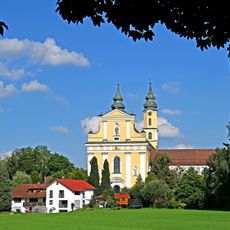
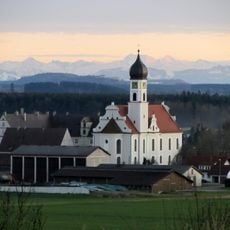
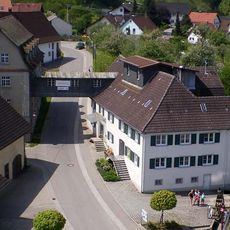
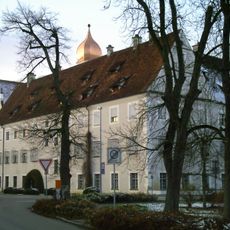
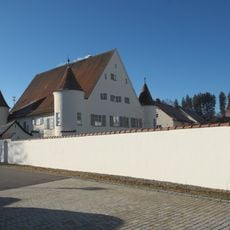
Rot an der Rot Abbey is a Premonstratensian monastery complex on a hill between the Rot and Haslach valleys. Its early Neoclassical abbey church of St. Verena, built 1777–1786, has a wide interior and is adjoined by Baroque convent buildings whose many small towers earned the nickname 'Upper Swabian Kremlin'. At the foot of the hill stands the rectangular economy building, now the town hall.
Founded around 1126 by Hemma von Wildenberg as a double monastery, Rot an der Rot was settled from Prémontré and became an abbey by 1140, mother house of Wilten, Weißenau, Schussenried, Steingaden, Kaiserslautern and Marchtal. Emperor Frederick Barbarossa took it under his advocacy in 1179; a fire in 1481 destroyed almost the whole complex, rebuilt until the new church was dedicated in 1509. Maximilian I raised it to Imperial Abbey in 1497, and in 1619 it obtained high justice.
The monastery is part of a region known for Baroque architecture and shows how religious communities transformed their buildings over centuries. The church and surrounding spaces reflect the value this monastic order placed on craftsmanship and spatial harmony.
The former abbey church of St. Verena and the convent buildings stand on a hill between the Rot and Haslach valleys; the economy building at the foot of the hill now houses the town hall. The church interior, with its choir stalls of 1691–1693 and the Holzhey organs, is the part to see. The complex is a station on the Upper Swabian Baroque Route.
The first prior, Burkhard, came from Prémontré near Laon with twelve French monks; by 1137 their work had already produced a daughter house at Wilten near Innsbruck. Under Abbot Ottino (1140–82) the community grew to about 200 monks and founded Weissenau, Schussenried, Steingaden, Kaiserslautern and Marchtal. A fire in 1182 destroyed the founding charters, which a papal bull of Lucius III replaced the same year.
The community of curious travelers
AroundUs brings together thousands of curated places, local tips, and hidden gems, enriched daily by 92,999 contributors worldwide.