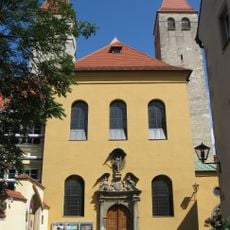
Niedermünster, Former canonesses' abbey in Regensburg, Germany
Niedermünster is a monastery complex in the old town of Regensburg, made up of a Romanesque church and adjoining residential and working buildings. The outer walls are built from heavy stone, with round-arched openings and solid pillars that are typical of this style.
A women's religious community was recorded here around 889, and a community had been founded by 788 under Duke Tassilo III of Bavaria. Henry I, Duke of Bavaria, rebuilt the church on a grand scale around 950 and was buried here; his widow Judith became abbess and was buried here in 990. In 1002 Emperor Henry II granted the community Reichsfreiheit, making it an Imperial abbey. The present Romanesque church was built after a fire in 1152, and the community was dissolved in 1803 during the secularisation of Bavaria.
Niedermünster shaped the religious life of women in Regensburg for centuries and left a clear mark on the city's old town. The church interior is plain and focused, designed for communal prayer rather than public spectacle.
The former canonry church, now the cathedral parish church, stands in Regensburg's old town near the cathedral. The community was dissolved in 1803, and from 1821 the buildings served as the bishop's residence and episcopal offices. Roman military foundations and earlier church remains found in excavations are shown only on guided tours.
Archaeological digs beneath the complex have uncovered remains of earlier structures that predate the current foundation. These findings show that the site was already in religious use well before the monastery was formally established.
The community of curious travelers
AroundUs brings together thousands of curated places, local tips, and hidden gems, enriched daily by 93,875 contributors worldwide.