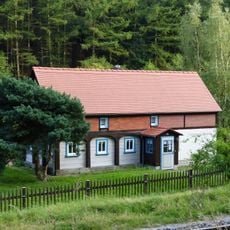
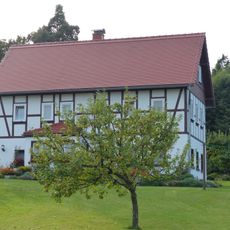
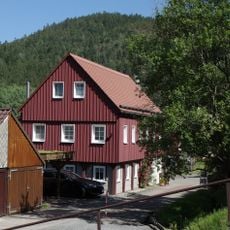
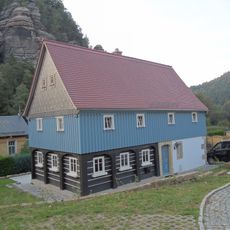
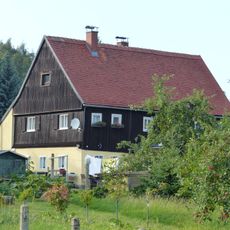
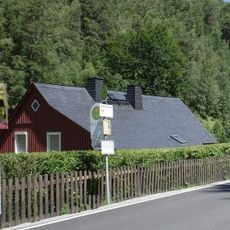
Ameisenberg, Mountain summit in Olbersdorf, Germany.
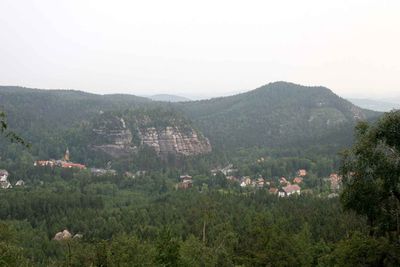
Ameisenberg rises to 575 meters elevation as a densely forested mountain with a distinctive conical shape, featuring steep eastern slopes that descend dramatically into the Oybin valley basin where the Töpfer river flows through deep terrain cuts.
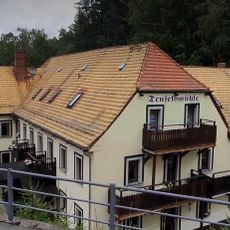
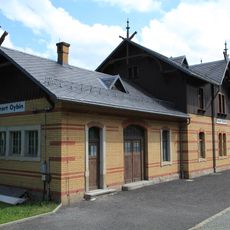
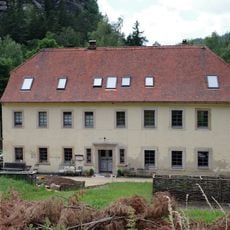
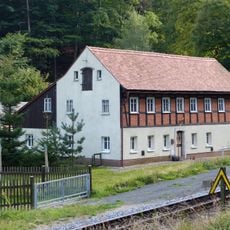
The Alte Leipaer Straße, an old trade road from Zittau to Česká Lípa, ran along the northern and western foot of the mountain, not over its summit. In the valley between Ameisenberg and Töpfer the Teufelsmühle mill stood, first recorded in 1562 as a sawmill and twelve years later as a grain mill; the narrow-gauge railway stop of the same name opened in 1897 and was closed from 1973 to 1990. Near the Hungerbrunnen spring on the western slope, members of the Oybin mountain club planted a Luther oak on 10 November 1883 for the 400th anniversary of Luther's birth.
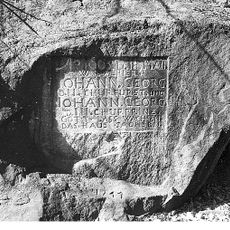
The name comes from a legend: a giant race at the foot of the mountain tyrannised the population until a hermit in the valley between Ameisenberg and Töpfer turned them all into ants at Pentecost. Near the Hungerbrunnen spring on the Alte Leipaer Straße stands the Brotstein, a sandstone block carved with a loaf and the year 1539, recalling a famine that spring.
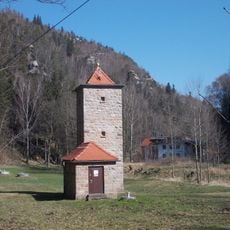
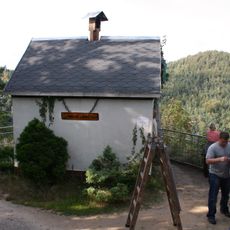
Trails reach the summit from Oybin and Olbersdorf; the Teufelsmühle stop on the Zittau narrow-gauge railway, in the valley between Ameisenberg and Töpfer, is a starting point for the climb. A shelter hut stands near the summit. The southeast slopes are closed to entry from mid-January to the end of June to protect nesting birds.
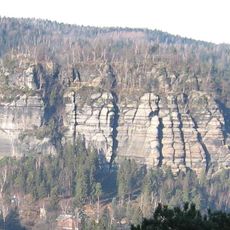
On the southeastern slope, rocks are protected as a bird nesting site, and entry there is usually forbidden from mid-January to the end of June. The rest of the mountain stays open, and the 15-metre sandstone tower Vergessener Turm southwest of the Teufelsmühle stop has 16 climbing routes, first climbed in 1937.
The community of curious travelers
AroundUs brings together thousands of curated places, local tips, and hidden gems, enriched daily by 94,642 contributors worldwide.