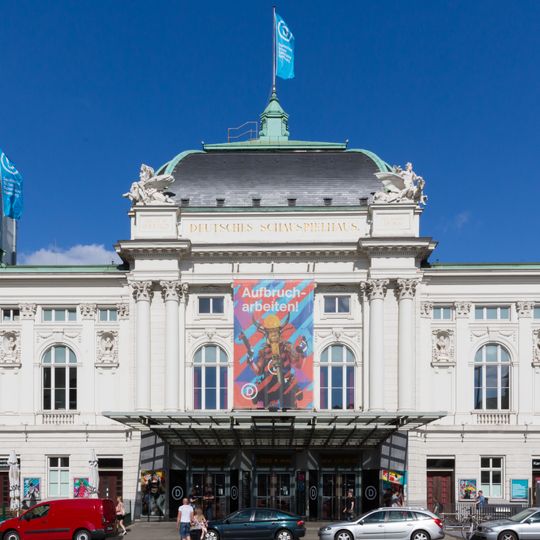
Deutsches Schauspielhaus, Neo-baroque theater in St. Georg, Hamburg, Germany
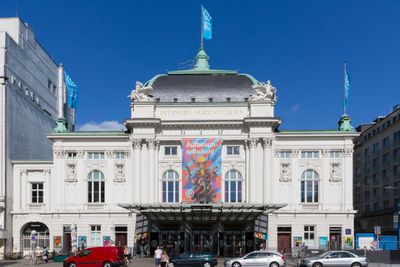
The Deutsches Schauspielhaus is a neo-baroque theatre in Hamburg's St. Georg district, designed by the Viennese firm Fellner and Helmer after the model of the Vienna Volkstheater. Its white facade has a projecting central bay inscribed DEUTSCHES SCHAUSPIELHAUS, tall columns and round-arched windows, and a green copper roof with a finial and flag. A dark canopy covers the glass entrance doors.
The Deutsches Schauspielhaus opened on 15 September 1900 with a prologue by Alfred von Berger and a performance of Goethe's Iphigenie auf Tauris. It was built between 1899 and 1900 to plans by the Viennese architects Fellner and Helmer, modelled on the Vienna Volkstheater, for a good million marks. The project grew from the Aktiengesellschaft Deutsches Schauspielhaus, founded in June 1899 with 84 shareholders, and counted the tragedian Franziska Ellmenreich among its backers.
The name refers to the tradition of German-language spoken drama, which is maintained here by a permanent ensemble. Visitors experience performances in a repertoire system, where different productions alternate on different evenings.
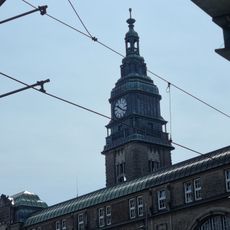
The building sits a few walking minutes from Hamburg Central Station and is easy to reach on foot. Performances usually take place in the evening, with different productions on consecutive days.
With 1192 seats, the building is considered the largest German spoken drama theatre. Since its opening, numerous premieres of major German-language playwrights have been presented here.
The community of curious travelers
AroundUs brings together thousands of curated places, local tips, and hidden gems, enriched daily by 92,933 contributors worldwide.