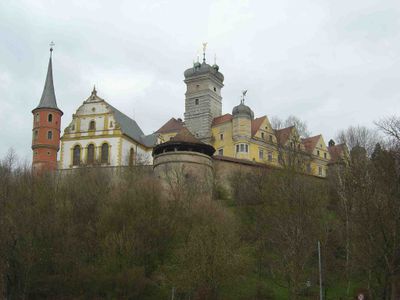
Schloss Schwarzenberg, Renaissance château in Scheinfeld, Germany
Schloss Schwarzenberg rises on a hillside above Scheinfeld as a group of connected wings. On the left stands a white and pale-yellow building with arched windows and a steep grey roof; at the centre a tall grey stone tower carries a green copper dome topped by a golden figure and cross. A long yellow wing with grey roofs and a smaller domed turret extends to the right, and a round grey stone bastion with a dark conical roof sits in front of the central tower. Medieval ramparts, casemates and defensive towers remain visible around the Renaissance building.
A medieval castle, first documented in 1150 and held by the Counts of Castell, burned down in 1607. Between 1608 and 1618 Count Wolfgang Jacob of Schwarzenberg had it rebuilt as a Renaissance château to plans by the Augsburg architect Elias Holl. The Black Tower was added in 1670–1674 to mark the family's elevation to imperial princes; the château remained the seat of the Schwarzenberg lordship until 1806.
The name Schwarzenberg refers to the hill itself, which appears dark from Scheinfeld due to its position between the slightly higher Altenberg and Neueberg and its woodland cover. Since 1968 the castle has housed a documentation centre for independent Czech literature, and Karel Schwarzenberg (1937–2023), former Czech foreign minister, lived here temporarily.
The castle can be visited through guided tours that offer access to the interior rooms and historical collections. Visitors should check in advance when tours are available and allow adequate time for a thorough visit.
The Black Tower, the castle's tallest structure, was built between 1670 and 1674 to mark the Schwarzenberg family's elevation to the rank of imperial princes. It replaced the medieval bergfried, which had survived the 1607 fire and stood until after 1670.
The community of curious travelers
AroundUs brings together thousands of curated places, local tips, and hidden gems, enriched daily by 93,095 contributors worldwide.