Wernigerode Castle, Neo-Gothic castle in Saxony-Anhalt, Germany
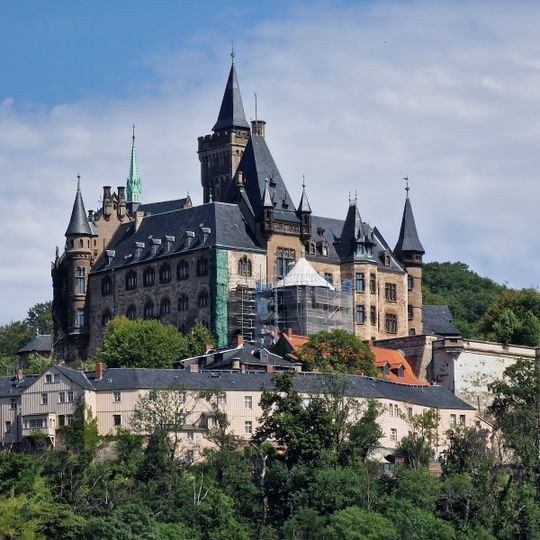
Wernigerode Castle stands on a slope of the Agnesberg above the town of Wernigerode in Saxony-Anhalt. Its present form, completed in 1893, is a historicist mix of neo-Gothic stone and half-timbered upper storeys, with around 250 rooms, numerous towers and steep slate roofs. The west and north facades incorporate the older Hofstubenbau, Steinernes Haus and Neues Haus.
Built between 1110 and 1120 above the settlement as a ring-shaped hilltop fortress, the castle was first recorded as "Castrum Wernigerode" in 1213. When the counts of Wernigerode died out in 1429, the counts of Stolberg inherited it. After the Thirty Years' War left it plundered and ruinous, it was rebuilt from 1671 to 1676 as a Baroque residence. Count Otto zu Stolberg-Wernigerode had it remodelled in historicist style between 1862 and 1885.
The castle houses a museum run by Schloß Museum GmbH, whose tour includes the Renaissance, Baroque and Classicist style rooms and the so-called King's Rooms in the west and north wings. The castle chapel, consecrated in 1883, has a choir with stained glass by Carl Christian Andrea.
The location is reachable from town via a clearly marked path, and multiple interior levels are open to visitors. Comfortable shoes are advisable since the climb to the building can be steep and touring the rooms involves considerable walking.
As you walk around the building's exterior, the asymmetrical shape and varying tower heights continuously reveal fresh perspectives from every vantage point. This quality makes it worthwhile to view the structure from all sides to appreciate its full architectural complexity.
The community of curious travelers
AroundUs brings together thousands of curated places, local tips, and hidden gems, enriched daily by 92,936 contributors worldwide.