Scheibenberg, Summit and geological formation in Ore Mountains, Germany
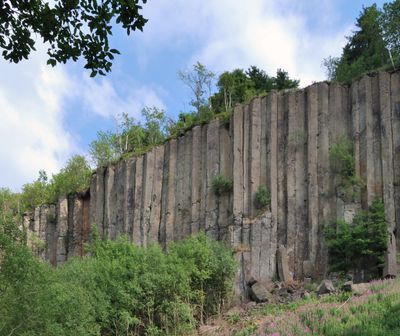
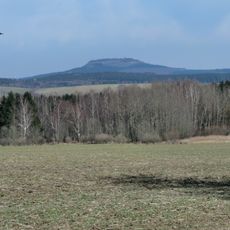
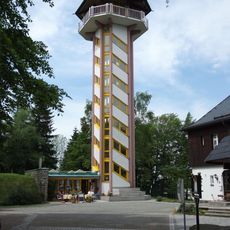
Scheibenberg is a mountain in the Ore Mountains of Saxony, Germany, rising to 807.2 m above sea level just southeast of the town of Scheibenberg. It is an erosion remnant of a Tertiary lava flow, made of augite-nephelinite that stands as columns up to nearly 30 metres high, known locally as "organ pipes". The summit carries a 29.2-metre octagonal lookout tower built in 1993/94 and a mountain inn.
The Scheibenberg is the eroded remnant of a Tertiary lava flow, its hard basalt now standing above softer surrounding rock. In 1787/88 the mineralogist Abraham Gottlob Werner examined the basalt resting on layers of sand and clay here and concluded that the rock had formed in the sea, founding the geological doctrine of Neptunism. The mountain belonged to the town of Scheibenberg from 1558, and basalt was quarried on its north side from 1914 until 1936.
The mountain draws walkers from nearby towns who come to see the basalt columns rising along the slopes. The sight of those stacked rock formations is something people often stop to photograph or simply stand before in silence.
Marked hiking trails lead to the basalt columns and up to the summit, where a lookout tower offers open views over the Ore Mountains. There is also a restaurant at the top, which makes it easy to take a break after the walk up.
In 2024 the International Union of Geological Sciences added the Scheibenberg geotope to its list of IUGS Geological Heritage Sites, the world's most important geological presentation sites. The basalt here is classified petrologically as augite-nephelinite, not true basalt, and stands in columns up to nearly 30 metres high, known locally as "organ pipes".
The community of curious travelers
AroundUs brings together thousands of curated places, local tips, and hidden gems, enriched daily by 92,807 contributors worldwide.