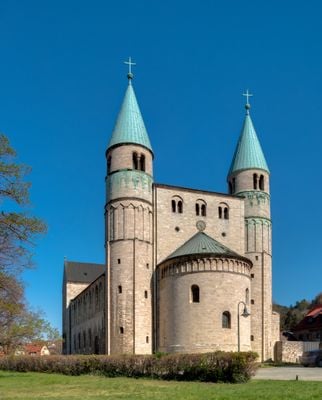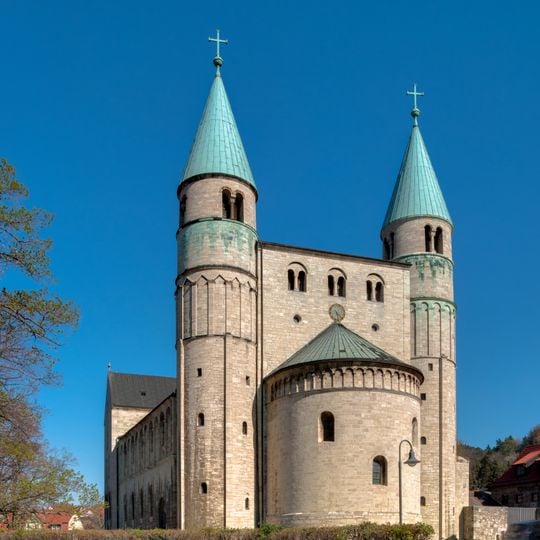
St. Cyriakus, Romanesque church in Gernrode, Germany
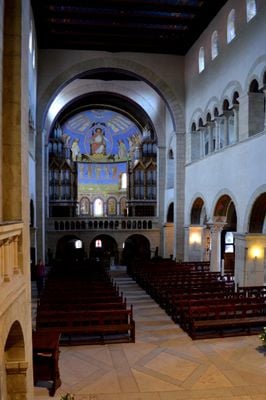
St. Cyriakus is an Ottonian church in Gernrode, built from 959/960 to 965, with a nave and two aisles, an eastern transept and a westwork flanked by two round towers. The west apse and west crypt were added around 1130. Inside, columns carry capitals with acanthus leaves and, on one, human heads; the nave galleries have semi-blind arcades.
Margrave Gero founded this church in 959 as part of a women's convent, which Otto I granted imperial status in 961. The site became an important center during the Ottonian period.
The church has been used by Gernrode's Protestant congregation since the Reformation was introduced in 1521 under Abbess Elisabeth von Weida. The abbess Anna von Plauen founded the town's first school in the 1530s, and from 1533 the collegiate church was shared with the parish. Visitors can see Gero's tomb slab in the crossing, carved with his armoured figure, sword, flag and a lion at his feet.
The interior is accessible to visitors, though opening hours vary significantly by season. It is worth checking current access times before your visit, as the building follows seasonal schedules.
In the south aisle stands a copy of Christ's tomb, probably made between 1080 and 1130; it is the oldest of its kind in Germany and differs markedly from the Holy Sepulchre in Jerusalem. When galleries were added in the 12th century, its entrance was moved from the east side to the north.
The community of curious travelers
AroundUs brings together thousands of curated places, local tips, and hidden gems, enriched daily by 94,447 contributors worldwide.