Ansgarkirche, Modern Lutheran church in Hamburg, Germany.
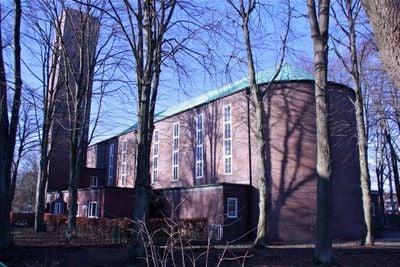
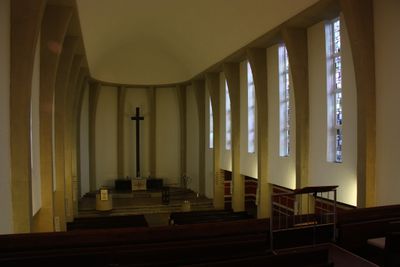
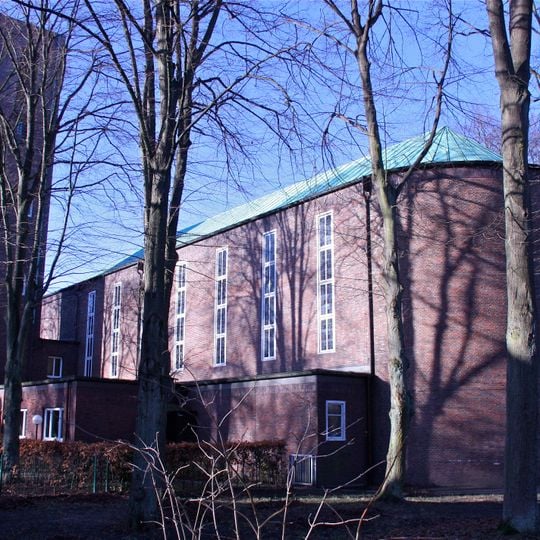
Ansgarkirche is a red-brown brick church in Hamburg-Langenhorn, built in 1929/1930 to a design by Herrmann Geißler and Otto Wilkening. Its central cubic body has a shallow green copper roof with radial seams, and a lower brick annex with a chimney-like projection extends to the left. Inside, slender concrete ribs arch upward to a white ceiling, with tall narrow windows between angled piers and dark wooden pews facing a dark wooden cross above a simple altar table.
The Ansgarkirche was built in 1929/1930 to designs by architects Herrmann Geißler and Otto Wilkening, and was the first church erected in the Langenhorn district of Hamburg. It was fully renovated in 2011.
The church is named after Saint Ansgar, the missionary associated with the Christian mission to Scandinavia. The black-and-white reproductions at the organ gallery show Anita Rée's 1931 designs for an altar triptych on the Passion of Christ; the originals were rejected in 1935 and never hung here. Two of Rée's 1930 designs were bought after a 2017–2018 Kunsthalle retrospective and shown in the church on 15 September 2018.
The church stands in Langenhorn, in Hamburg's north. The slim, flat-roofed tower holds three bronze bells cast for the C, F-sharp and A notes, moved here in 2008 from the Kapernaumkirche in Horn; two old steel bells from 1930 stand outside beside the building. Inside, the classic layout with side aisles and a rounded apse keeps the altar visible from the pews.
The organ was designed by Hans Henny Jahnn and installed in 1931 by P. Furtwängler & Hammer; its pipework remains original. It is one of the few surviving Jahnn organs and one of the first large organs of the Organ Reform movement with mechanical action. Its stops are split into a feminine side (left) and a masculine side (right).
The community of curious travelers
AroundUs brings together thousands of curated places, local tips, and hidden gems, enriched daily by 93,666 contributors worldwide.