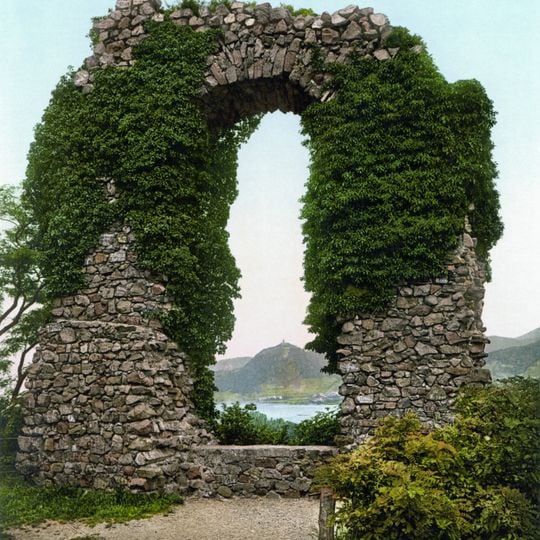
Burg Rolandseck, Medieval castle ruins in Rolandswerth, Germany
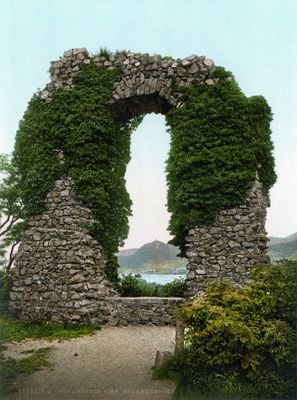
Burg Rolandseck is a ruined hill castle on a 155.2 m basalt rock below the Rodderberg, above the Middle Rhine Valley in Remagen-Rolandswerth. Of the whole complex only one castle window survives, the Rolandsbogen: an upright inverted-U opening of rough grey and brown stone in visible courses, its piers rising from a low foundation wall. Dense ivy grows down both sides and across the top curve, leaving patches of the base and inner edges exposed.
The fortress was founded in 1122 by Archbishop Friedrich I of Cologne to secure the southern frontier of his diocese, working in tandem with a nearby women's convent. An earthquake in 1673 toppled most of the structure, yet one window frame endured and eventually became the site's defining symbol.
The ruins became a subject of fascination for painters and writers who sought to capture their romantic forms on canvas and in verse. This attraction grew from the evocative quality of broken stone set against the river landscape.
Admission to the ruins is free and open year-round, allowing visitors to view the remains from multiple vantage points. A restaurant nearby serves food and drinks with views across the valley, making it easy to linger and take in the location.
The surviving window arch collapsed on 28 December 1839. The poet Ferdinand Freiligrath, then living in Unkel, appealed for donations in the Kölnische Zeitung, and the arch was rebuilt in 1840 to plans by Cologne cathedral architect Ernst Friedrich Zwirner. A monument on the footpath from the Rhine valley honours Freiligrath.
The community of curious travelers
AroundUs brings together thousands of curated places, local tips, and hidden gems, enriched daily by 92,842 contributors worldwide.