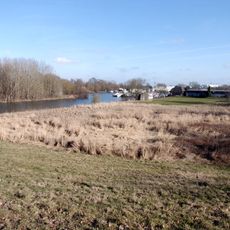
Antarctic Technology Offshore Lagoon Laboratory, Floating oceanographic laboratory in Bergedorf, Germany.
The Antarctic Technology Offshore Lagoon Laboratory was a floating oceanographic lab built from three curved fiberglass elements, each 25 m long with a draught of only 38 cm. In operation they formed a horseshoe around 150 m² of water; for towing they could be joined into a long S-shape. The hulls were bought from Waki Zöllner's "Atoll" company.
The facility operated from 1982 to 1995 at the University of Kiel's Institute of Oceanography and supported research on marine life. During this time it contributed to developing technologies later used for polar expeditions.
The lab's name echoes Waki Zöllner's floating bathing island "Atoll", whose fiberglass hulls were bought for the research station. From its NeXT computer, the first images of ocean critters on the internet were sent via radio link, and the first in situ videos of Atlantic herring feeding on copepods were recorded there.
The three fiberglass elements could be joined into a long S-shape for towing and opened into a horseshoe around 150 square metres of water while in use. Each element was 25 metres long with a draught of only 38 centimetres, so the lab could float in shallow coastal water. An underwater room with large portholes allowed researchers to watch and handle organisms directly.
The facility used a NeXT computer system that enabled the development of early virtual microscopes for studying Antarctic krill. This was a breakthrough in computer-assisted visualization of marine organisms.
The community of curious travelers
AroundUs brings together thousands of curated places, local tips, and hidden gems, enriched daily by 93,095 contributors worldwide.