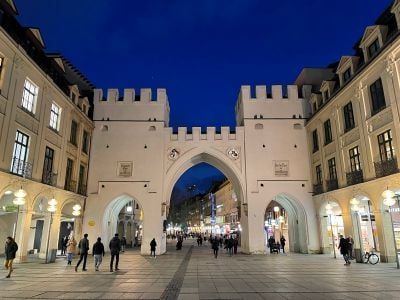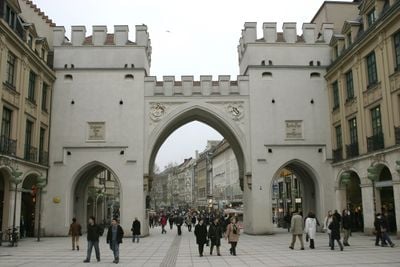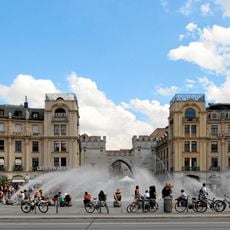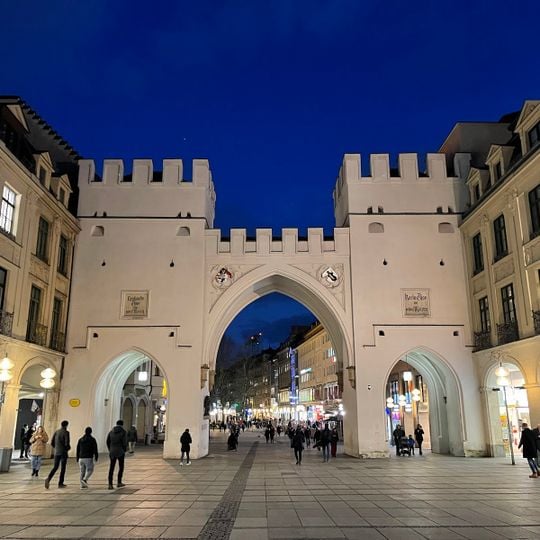
Karlstor, Medieval gate tower at Karlsplatz, Munich, Germany.
Karlstor is a gate structure with two side towers connected by a large central arch at Karlsplatz. The building marks the western entrance to Munich's pedestrian shopping district and functions as a passage linking the plaza to the main commercial street.
Built around 1300 as Neuhauser Tor, the gate was first documented in 1302 within Munich's second city wall. In 1791 Count Rumford rebuilt the flanking towers and the gate was renamed Karlstor. A gunpowder explosion in 1857 so damaged the main tower that it was later demolished; Arnold Zenetti gave the gate its Neo-Gothic form in 1861–62.
On the four ribs of the central vault are small stone sculptures of Munich originals: Josef Sulzbeck, a folk singer; Georg Pranger, the last Bavarian court jester under Max I Joseph; Joseph Huber, known as Finessensepperl, who carried love letters; and horse dealer Franz Xaver Krenkl, credited with "Wer ko, der ko".
The gate is easily accessible on foot and serves as a natural crossing point between the plaza and the shopping zone. The wide central passage allows comfortable movement even during busy times.
The brick escape tunnel found beneath the gate in 1970 came to light during construction of the Stachus underground shopping centre, not through archaeological excavation. It let soldiers, and possibly civilians, slip behind enemy lines. A short section is displayed on the first basement level at the centre's Brunnenplatz.
The community of curious travelers
AroundUs brings together thousands of curated places, local tips, and hidden gems, enriched daily by 92,899 contributors worldwide.