Church of the Redeemer, Bad Homburg, Protestant church in Bad Homburg, Germany
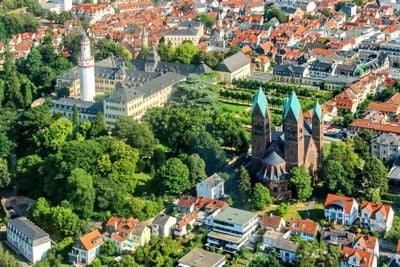
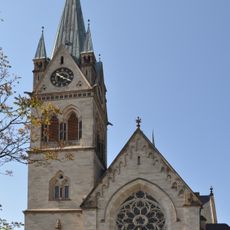
The Church of the Redeemer is a Protestant church in Bad Homburg featuring a cross-shaped basilica with four towers of varying heights. The taller choir at the altar contrasts with the lower entrance section, creating a clear vertical hierarchy within the space.
Plans for a Protestant parish church dated to the early 19th century but were realized only under Emperor Wilhelm II and Empress Auguste Viktoria, who funded the project and took part in pre-planning. Berlin architect Max Spitta was commissioned in 1901; after his death in December 1902, Franz Schwechten took over. The foundation stone was laid in 1903, the shell was completed in 1905 by Philipp Holzmann of Frankfurt, and the church was inaugurated on 17 May 1908 in the presence of the imperial couple.
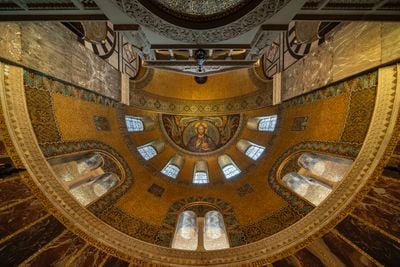
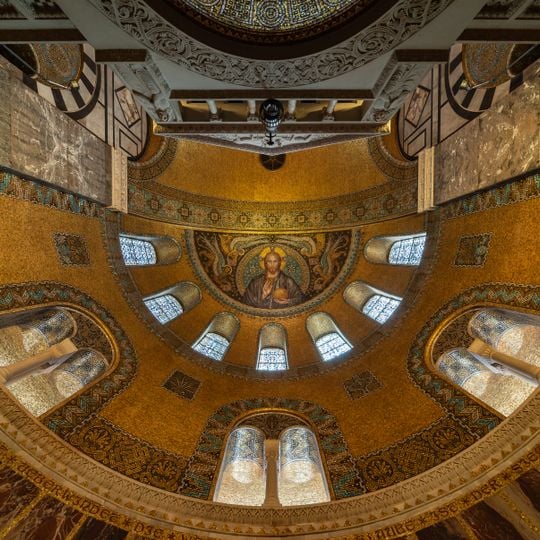
The name Erlöserkirche refers to Christ the Redeemer, and the mosaic programme follows that theme, culminating in the Pantocrator in the apse half-dome. In the dome, a cycle known as the Wheel of Life recurs. The interior mixes Byzantine models with Art Nouveau, and contemporaries already compared it to the cathedral of Cefalù in Sicily.
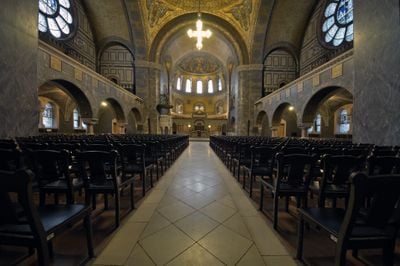
The church stands at Dorotheenstraße 1 in Bad Homburg's Innenstadt, a short walk from the Kurpark. Visitors enter through the main portal on the entrance side; the altar and apse lie at the opposite, southwest end. The imperial box has its own separate entrance. The interior is a centralised space, so the gold mosaics of the dome and apse can be viewed from the nave without a fixed route.
Empress Auguste-Viktoria gifted the church with a jewel-decorated altar cross originally intended for the Church of the Redeemer in Jerusalem. This rare donation shows the close connection between the German imperial family and this site.
The community of curious travelers
AroundUs brings together thousands of curated places, local tips, and hidden gems, enriched daily by 93,449 contributors worldwide.