Weißer Turm, Medieval tower in Bad Homburg vor der Höhe, Germany.
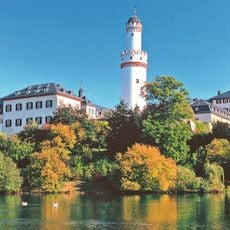
The Weißer Turm is a cylindrical structure with a white plastered exterior and red decorative elements that rises approximately 48 meters high. The upper section displays a distinctive form with ten window openings created from earlier defensive features.
The structure was built between 1355 and 1370 as a defensive tower of Hohenberg Castle and was later repurposed as a symbolic monument during the castle's conversion to a residence in the 17th century. This transformation reflects the shift from military to representational function.
The tower's name comes from the white plaster that coats it today, with red-painted battlements, friezes and window frames. At its foot, on the east side, stands a sandstone statue of Landgrave Friedrich VI in late-medieval armour, carved by Johann Baptist Scholl of Darmstadt in 1849 and set up by his brother Ferdinand, the last landgrave. The tower is Bad Homburg's town landmark.
Access involves climbing 174 steps that lead to an observation platform offering views across the town. Opening times are limited to the warmer months, so it is best to check conditions before planning a visit.
The gilded sphere sits not inside the tower but beneath the weather vane, renewed in 1704 and bearing the intertwined monogram of Friedrich II. It holds a small archive of the Hessen-Homburg family. At the tower's foot, a sandstone statue of Landgrave Friedrich VI in late-medieval armour, carved by Johann Baptist Scholl of Darmstadt in 1849, stands in an eastern niche.
The community of curious travelers
AroundUs brings together thousands of curated places, local tips, and hidden gems, enriched daily by 93,428 contributors worldwide.