Schloss Muskau, Neo-Renaissance castle in Bad Muskau, Germany
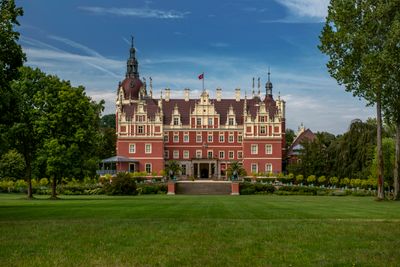
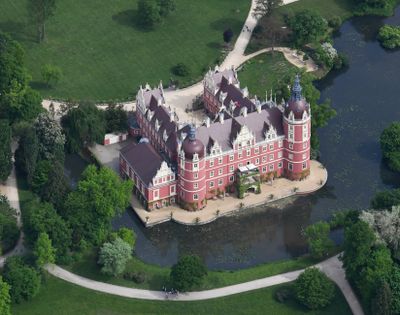
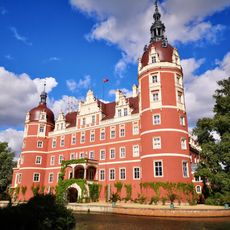
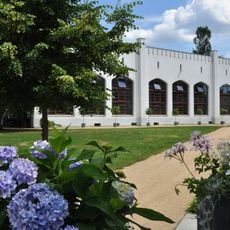
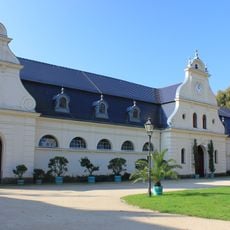
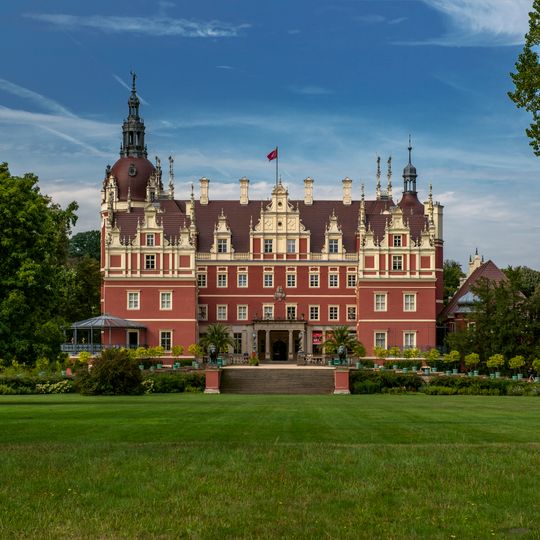
Schloss Muskau is a castle complex in Bad Muskau whose main building, the New Palace, is a three-winged Neo-Renaissance structure built from 1863 to 1866 for the Prince of the Netherlands by architects Maximilian Franz Strasser and Hermann Wentzel. Its courtyard opens east toward the park, reached by a large ramp designed by Schinkel. The four-storey central wing carries two round towers of unequal height, and the side wings are three storeys high. The south gable bears sandstone figures of the two architects.
The New Palace was rebuilt in Neo-Renaissance style between 1863 and 1866 for the Prince of the Netherlands, on foundations of a medieval water castle and a first palace of 1520/30; its architects Maximilian Franz Strasser and Hermann Wentzel are shown as sandstone figures on the south gable. The so-called Old Castle is a 16th-century Renaissance building that never served as a castle: Curt Reinicke II von Callenberg converted the former gatehouse into an administrative seat after 1672, and Hermann von Pückler later gave it the name as a status symbol for his park.
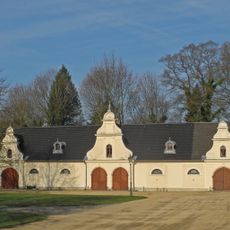
The name "Old Castle" for the former gatehouse comes from Hermann von Pückler, who wanted an older building as a status symbol for his park, as in British landscape gardens. Above its baroque portal stand figures of the Wild Man, Muskau's herald, Flora and Hygeia, carved by Werner Hempel and placed in 1974. The building now houses the town museum and registry office, with a small concert hall in the converted attic.
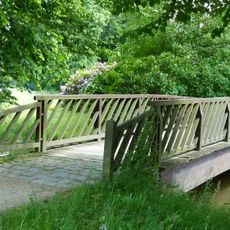
You can walk freely between the German and Polish sections without border checks, following numerous pathways throughout the grounds. The park is easiest to explore in dry weather, when paths are firm and the landscape shows its full character.
The Old Castle was never a castle: it is the gatehouse of the former fortress, rebuilt as an administrative seat by Curt Reinicke II von Callenberg after 1672. Hermann von Pückler gave it the name because his park needed an older building as a status symbol, as in British landscape parks.
The community of curious travelers
AroundUs brings together thousands of curated places, local tips, and hidden gems, enriched daily by 94,242 contributors worldwide.