Berlin-Pankow station, Railway station in Pankow, Germany
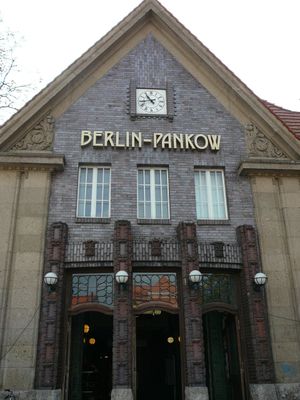
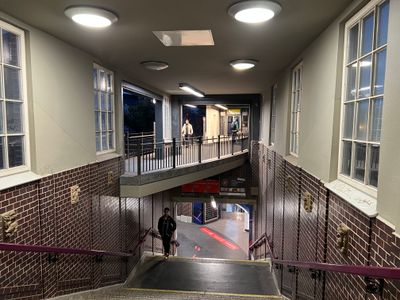
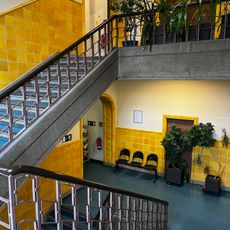
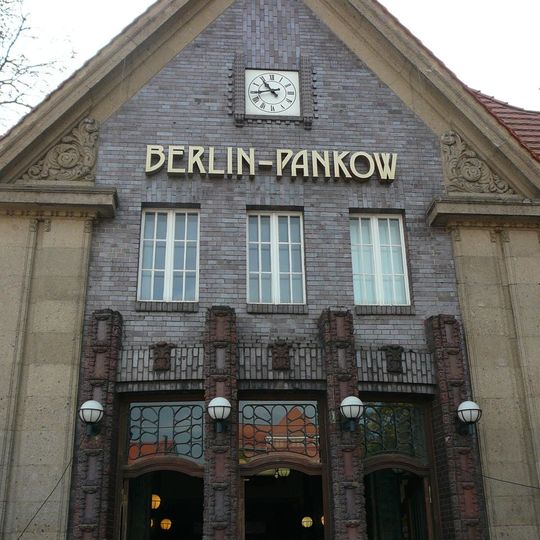
Berlin-Pankow is a station on the Berlin–Szczecin railway in the Pankow district. Its grey brick entrance building, built 1909–1914 to plans by Karl Cornelius and Ernst Schwartz, has a round white clock with Roman numerals in a square stone frame and gold serif lettering reading "BERLIN-PANKOW" above three mullioned windows. Three arched openings with black grilles and red-orange curved designs sit between dark red brick columns. A tiled pedestrian underpass with yellow-edged stair treads and curved reliefs leads down to the platforms.
The first stop opened on 15 October 1880, about a kilometre from Pankow's old centre, and was soon renamed Pankow-Schönhausen after nearby Schönhausen Palace. The reception building on the north side was built from 1909 to 1914 to plans by Karl Cornelius and Ernst Schwartz. Electric operation on the suburban line began on 8 August 1924, and the station has been called Berlin-Pankow since 3 October 1954.
The station's name changed to Berlin-Pankow on 3 October 1954, when the formerly independent municipality of Pankow was merged into Berlin. Its earlier name, Pankow-Schönhausen, referred to Schönhausen Palace in nearby Niederschönhausen. The name Bahnhof Pankow had previously belonged to the nearby Nordbahn station, today Wollankstraße.
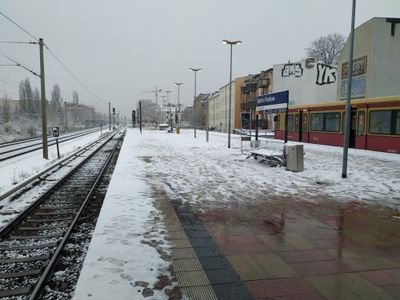
The station connects through multiple S-Bahn lines and regional trains with direct service to central Berlin and communities across Brandenburg. Signage and information points help visitors navigate the space and find their desired routes.
The former marshalling yard northeast of the passenger station, built 1891–1893 for 8.9 million marks, handled over 3,800 wagons in a single day in 1917, making it the largest one-sided marshalling yard in the German Reich. It closed in 1997.
The community of curious travelers
AroundUs brings together thousands of curated places, local tips, and hidden gems, enriched daily by 92,845 contributors worldwide.