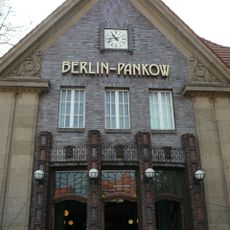
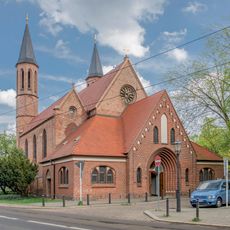
Jewish Orphanage Berlin-Pankow, Architectural heritage monument in Pankow, Germany.
This building in Pankow was constructed between 1912 and 1913 by architect Alexander Beer and combines classrooms, dormitories, and communal spaces in one structure. The layout shows how living and learning areas were organized together within the same building.
The orphanage began in 1882 when Berlin's Jewish community took over a home for 39 refugee boys from Russian pogroms. After a 1911 fire, Alexander Beer designed the neo-baroque building erected in 1912/13. It operated until December 1940, when it was merged with the Auerbach orphanage; the last residents were deported to camps in 1942.
The building now houses the Janusz Korczak district library (since 2001) and the SchuleEins comprehensive school (since 2007), and serves as a cultural centre and meeting place. Since its 2001 reopening it has hosted events promoting communication as a means of information and peacekeeping; from this came the Pankower Waisenhausgespräche series, launched in 2007. An association of friends and sponsors, including Jutta Limbach, Wolfgang Thierse and the late Christa Wolf, keeps the memory of the orphanage alive.
The building is located in Pankow and is easily accessible by Berlin's public transportation. It operates as a library today, so visitors should plan ahead and check when it is open.
Beer designed the layout so that teaching and living could happen under one roof in an efficient way. This approach was innovative for early 20th-century orphanage design and planning.
The community of curious travelers
AroundUs brings together thousands of curated places, local tips, and hidden gems, enriched daily by 94,123 contributors worldwide.