Pankow village church, Parish church in Pankow district, Germany.
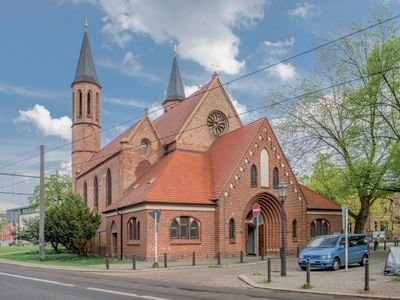
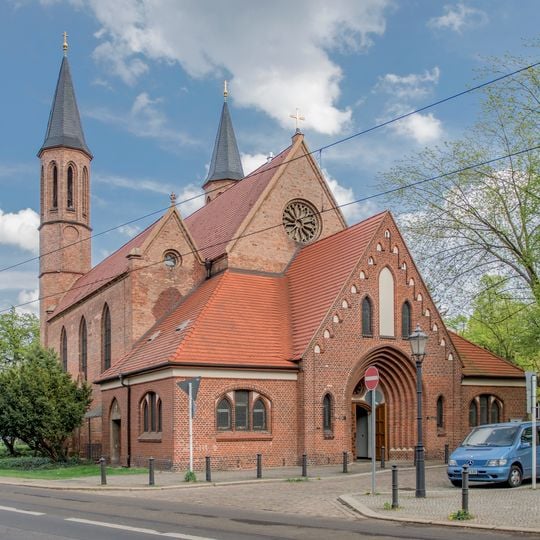
Pankow village church is a brick building with neo-gothic design and two octagonal towers reflecting the Schinkel architectural school. The interior features a clear, functional layout typical of Protestant churches from this period.
Pankow was founded around 1230 as an Angerdorf; a wooden church probably stood on the green, and a pastor with four parish hides is recorded in Charles IV's Landbuch of 1375. In the 15th century a fieldstone hall church replaced it, its windows framed in brick. Friedrich August Stüler added the three-aisled brick nave with two octagonal flanking towers in 1857–1859; the towers were rebuilt in 1953 after wartime damage.
The church has been the mother church of Niederschönhausen since 1541, and a 1541 visitation record lists 80 communicants at the introduction of the Reformation in Brandenburg under Elector Joachim II. The neo-Gothic pulpit and baptismal font date from 1860, and a Coventry Cross from 1964 hangs beneath the gallery.
The church holds regular services and is therefore accessible at specific times. Visitors planning to attend outside of scheduled services should check opening hours beforehand to ensure access.
The two stained-glass windows of the Four Evangelists by Inge Pape were installed in 1959 in the east side of the church, not spread through the nave. They sit in the medieval fieldstone choir, whose east gable keeps its original brick tracery with paired pointed blind arches and seven pinnacles.
The community of curious travelers
AroundUs brings together thousands of curated places, local tips, and hidden gems, enriched daily by 94,456 contributors worldwide.