Gottorf Castle, Renaissance château in Schleswig, Germany
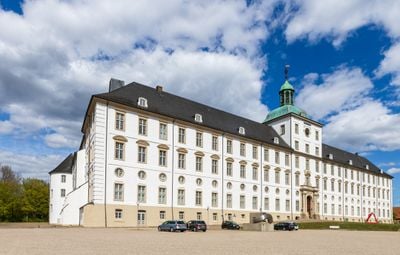
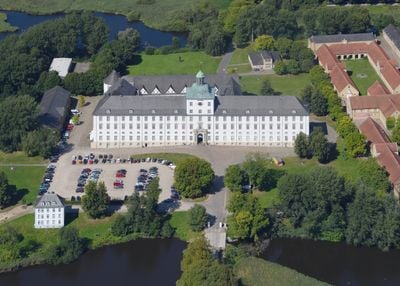
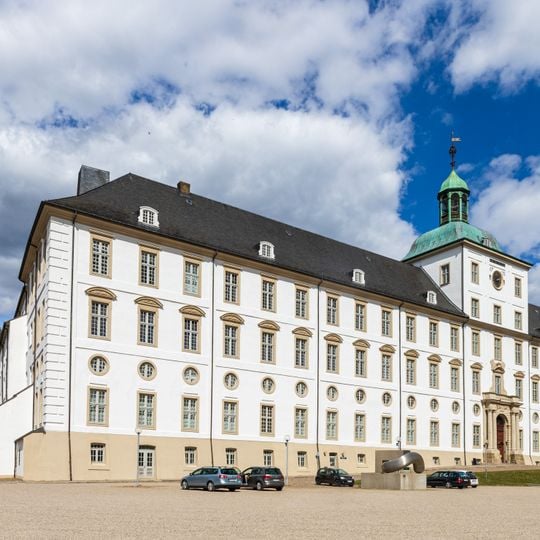
Gottorf Castle stands on an island in the Schlei. Its white-plastered main block has four upper floors of rectangular windows with light stone surrounds, a row of small round windows between the second and third rows, and a stone entrance portal with a curved pediment. A green copper dome with a lantern and weather vane sits at the right end of the dark, steeply pitched roof. A second four-storey block with two projecting wings and a central clock tower rises behind a gravel forecourt.
The castle was founded in the Middle Ages and transformed after 1530 when Duke Frederik made it his primary residence and converted it into a Renaissance fortress. This renovation solidified the site's role as a political center for the region.
The castle gave its name to the House of Schleswig-Holstein-Gottorp, whose line produced four Swedish kings and several Russian emperors in the 18th century. Court scholar Adam Olearius, secretary of the 1636–1638 embassy to Isfahan, designed the Persian-style Globus House in the Neuwerk garden. The Gottorf giant globe, the library and the art chamber were famous across Europe. Most showrooms have been closed since 31 August 2025 for about three years of renovation.
Most of the exhibition rooms have been closed since 31 August 2025 for renovation expected to last about three years; the bog bodies are shown during this period at the museum in Silkeborg, Denmark. The castle stands on an island in the Schlei west of Schleswig's old town, and the reconstructed Neuwerkgarten terrace garden lies to its north.
The Gottorf Giant Globe, built at the court of Duke Frederick III, was reconstructed and stands in the Neuwerk garden north of the castle. The original globe, made in the 17th century, was taken to Copenhagen and later to Saint Petersburg.
The community of curious travelers
AroundUs brings together thousands of curated places, local tips, and hidden gems, enriched daily by 93,071 contributors worldwide.