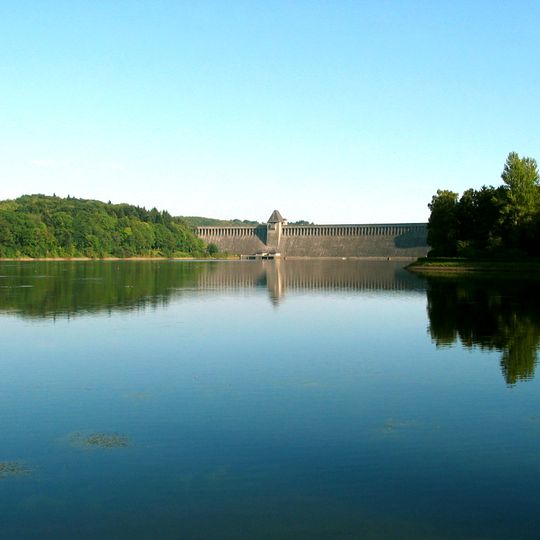
Möhne Reservoir, Artificial reservoir in Sauerland, Germany
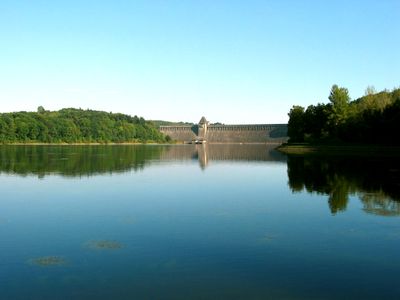
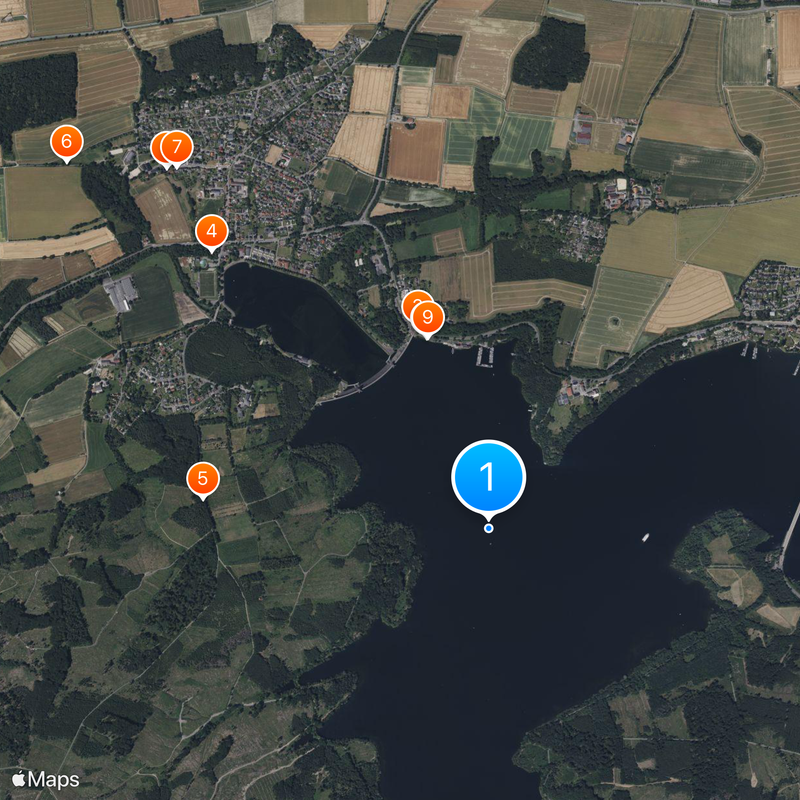
Möhne Reservoir is an artificial body of water in the Sauerland region, located between Soest and Arnsberg in North Rhine-Westphalia. The four connected basins store a combined total of 135 million cubic meters of water and are enclosed by a dam made of quarried stone.
The Ruhrtalsperrenverein began building the dam in January 1908 to plans by Ernst Link, a pupil of Otto Intze; it was inaugurated on 12 July 1913 and was then Europe's largest dam. On the night of 16–17 May 1943, RAF Lancaster bombers of Operation Chastise breached the wall with bouncing bombs, and the flood killed at least 1,579 people. Organisation Todt repaired the dam by 23 September 1943.
The name comes from the Möhne river, which runs through forested valleys before being dammed at this point. Visitors often encounter the water while walking or cycling along the shore, where viewpoints and small restaurants offer places to pause.
A visit works well at any time of year, though spring and summer offer more options for walking and cycling. The paths along the water are mostly flat and well surfaced, making them suitable for families with children.
The dam's deepest point, 36 metres, lies at the Link Tower, named after the RTV construction director Ernst Link. The commemorative plaque from the 1913 inauguration disappeared after the war and now hangs in the Canberra War Museum; a replacement is mounted in the right sliding-gate tower.
The community of curious travelers
AroundUs brings together thousands of curated places, local tips, and hidden gems, enriched daily by 93,845 contributors worldwide.