SM U-1, Military submarine at Deutsches Museum, Munich, Germany
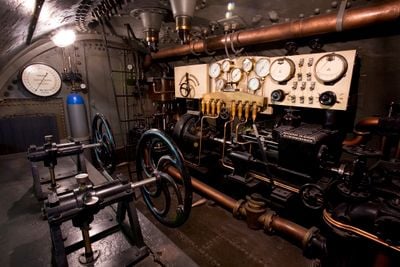
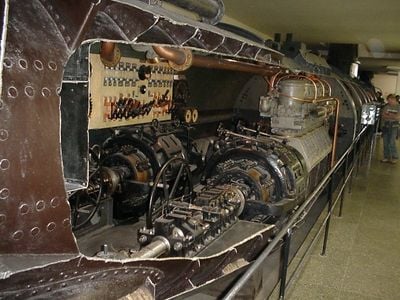
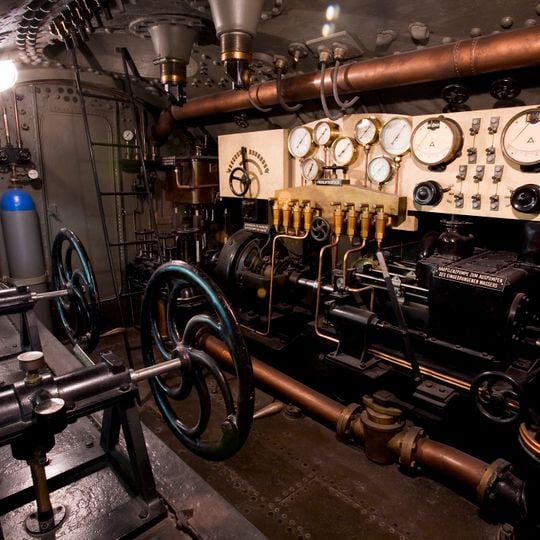
SM U-1 is a submarine with an overall length of 42.39 m and a pressure hull 32.50 m long, displayed at the Deutsches Museum in Munich. A large section of the starboard hull has been removed, revealing the cramped interior: a riveted dark metal compartment with a bronze-colored pipe, a white engine control panel labeled "VORWÄRTS RÜCKWÄRTS" and "LANGSAM SCHNELL" with 12 circular gauges, and a plate reading "BARTZ & CO. ZÜND-APPARATE FÜR EXPLOSIONS-MOTOREN." Two large blue-spoked wheels and two black electric motors with exposed copper windings are also visible.
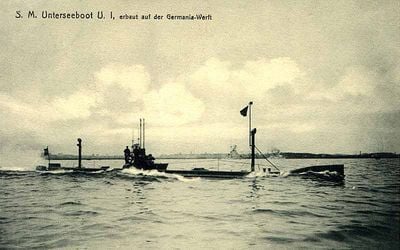
Ordered on 3 December 1904 from Germaniawerft in Kiel, SM U-1 was commissioned on 14 December 1906, making Germany the last major European navy to adopt submarines. Its design was a revised Karp-class boat by the Austrian-born Spanish engineer Raimundo Lorenzo de Equevilley Montjustín, with trim tanks, a strengthened pressure hull and external fuel tanks. Deemed obsolete in 1914, it served as a training boat until 19 February 1919, when it was struck by another vessel during an exercise.
The "U" stands for Unterseeboot, the term the Imperial Navy used for its submarines. During Kiel Naval Week in March 1907, the commander was awarded the Order of the Red Eagle after hitting the light cruiser München, carrying Kaiser Wilhelm II, with two exercise torpedoes.
A large portion of the starboard hull has been removed, so visitors look into the interior from the side rather than walking through the boat. The view takes in the cramped engine room, with its control panel, gauges and blue-spoked wheels. The submarine sits indoors in the Deutsches Museum, so access is level and step-free.
The submarine used kerosene-paraffin engines made by Körting Hannover instead of gasoline motors, making it safer and setting new standards for undersea propulsion. This choice influenced the design of many later submarines.
The community of curious travelers
AroundUs brings together thousands of curated places, local tips, and hidden gems, enriched daily by 92,892 contributors worldwide.