Wahnfried, Renaissance Revival villa in Bayreuth, Germany.
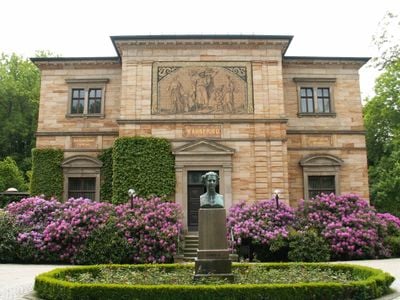
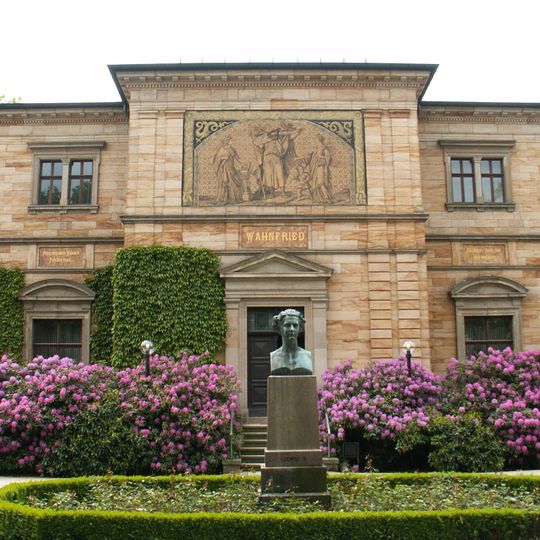
Wahnfried is a two-story stone villa built from 1872 to 1874 by Carl Wölfel, using altered plans by Wilhelm Neumann. Its facade of tan and pale brown rectangular blocks has a central projecting section with a relief panel and the inscribed plaque "WAHNFRIED". A bronze bust of King Ludwig II stands before the entrance, which is framed by a triangular pediment and flanked by green-shuttered windows.
The building was completed in 1874 and served as Wagner's residence until his death in 1883. Following changes and reconstruction during the 1900s, it became a museum dedicated to preserving the composer's legacy.
The villa's name reflects Wagner's own desire for a place of retreat and creative work, which shapes how the rooms are arranged and experienced today. The interior spaces tell stories of daily life through preserved furnishings and personal objects that reveal his habits and interests.
The site is easily accessible by public transportation and visitors can explore independently or with a guide. Plan enough time to see the different rooms and rotating exhibitions at a comfortable pace.
The motto above the entrance is in German, not Latin: "Hier wo mein Wähnen Frieden fand – Wahnfried – sei dieses Haus von mir benannt." It gave the villa its name, a compound of Wahn (delusion) and Friede (peace), and amused local townsfolk when it was engraved.
The community of curious travelers
AroundUs brings together thousands of curated places, local tips, and hidden gems, enriched daily by 93,933 contributors worldwide.