Abbey of Saint Peter in the Black Forest, Benedictine monastery in Sankt Peter, Germany
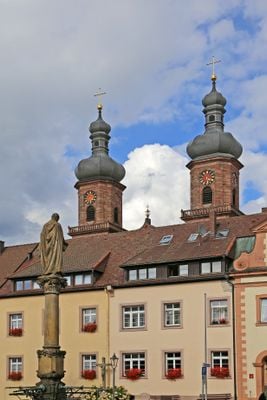
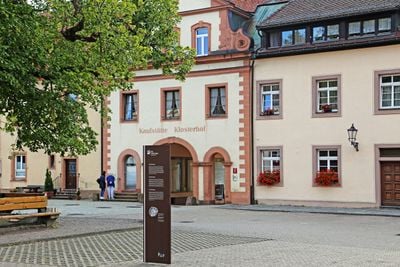
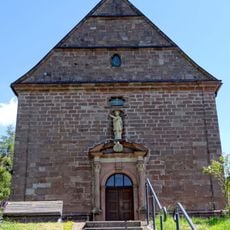
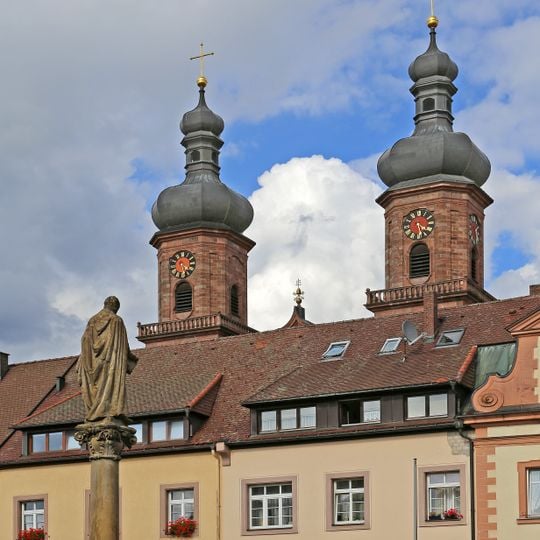
The Abbey of Saint Peter is a former Benedictine monastery in Sankt Peter im Schwarzwald. Its Baroque church, built in the 1720s by Peter Thumb, has two brick towers with grey onion domes, red-faced clocks and golden finials. The cream-coloured Kaufstätte Klosterhof facade has three ground-level arches and reddish-brown stone trim.
The community began in Weilheim in or before 1073 and moved to Hirsau after 1078; Duke Berthold II of Zähringen resettled it at St. Peter by 1093, with his wife Agnes of Rheinfelden providing inherited Burgundian estates. A papal privilege of 10 March 1095 placed it under Rome. Fires struck in 1238 and 1437, and the abbey was dissolved in 1806.
The abbey church holds 55 ceiling frescoes painted by Franz Joseph Spiegler in 1727, with sculptures by Joseph Anton Feuchtmayer. The village and monastery take their name from Saint Peter. Since 2006 the former monastic buildings have served as the Geistliches Zentrum St. Peter, a spiritual centre of the Archdiocese of Freiburg.
The former monastery lies in the village of St. Peter im Schwarzwald, in the Breisgau-Hochschwarzwald district. Since 2006 it has been used as the Geistliches Zentrum St. Peter, so parts of the complex are given over to that centre rather than being open to casual wandering. The church, with its two onion towers, faces the village centre; the building inscribed "Kaufstätte Klosterhof" stands nearby.
The monastery is one of the few Baroque complexes in the region that has preserved its original architecture from the 1720s to the present day. This continuity makes it a rare testimony to the craftsmanship and building techniques of that era in the Black Forest.
The community of curious travelers
AroundUs brings together thousands of curated places, local tips, and hidden gems, enriched daily by 94,387 contributors worldwide.