Trier Imperial Baths, Roman thermal complex in Trier, Germany
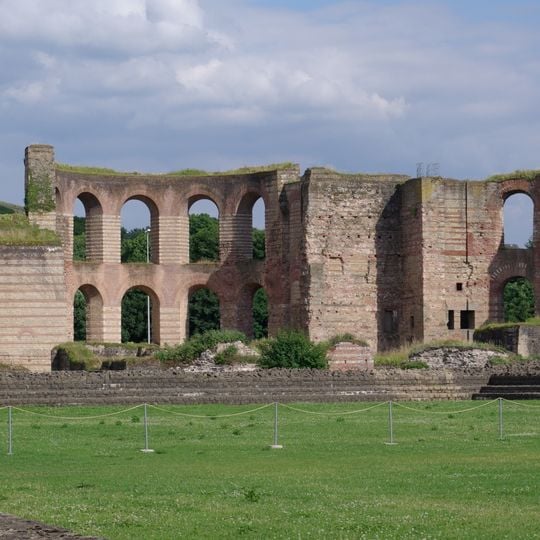
The Imperial Baths (Kaiserthermen) are the monumental ruins of a late Roman bath complex in central Trier, with walls still standing up to 19 metres high. The surviving structure includes a ruined wall of reddish-brown brick and grey stone, its left section pierced by two rows of four arched openings, while the right section is a solid block with a single large arch. The baths were divided into a palaestra measuring 160 by 130 metres and a main bath building to the west.
Construction began around 300 CE under Emperor Constantius Chlorus as a prestige project for the city but was abandoned unfinished in 316 CE. The complex shows traces of the political upheaval of that era and was later partly repurposed as a fortification.
The name Kaiserthermen dates from later tradition; the baths were never finished, and in the Middle Ages the core was called Alteburg and served as a castle and city-wall bastion. Around 1100 the parish church of St. Gervasius rose on the palaestra, and in 1295 the monastery church of St. Agneten opened at its north corner.
The site is accessible to visitors daily, with opening hours varying by season. It is wise to wear sturdy footwear since the underground terrain is uneven, and temperatures in the passages remain cool.
The service corridors beneath the bath floor are open to visitors, and the site's sewer remains can still be traced. The west part of the complex stayed unexamined until the winter of 1944/45 destroyed the modern buildings above it, letting Wilhelm Reusch excavate 10,800 square metres of the Roman city block from 1960 to 1966.
The community of curious travelers
AroundUs brings together thousands of curated places, local tips, and hidden gems, enriched daily by 93,099 contributors worldwide.