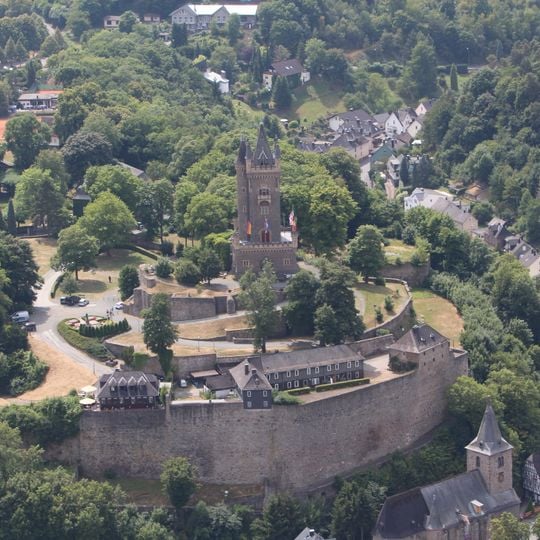
Dillenburger Schloss, Castle ruins in Dillenburg, Germany
Dillenburger Schloss is a ruined fortress on the Schlossberg above Dillenburg, of which the 16th-century casemates with loopholes for hand firearms survive, along with the Hohe Mauer built from 1523 to 1536 under Ulrich von Ansbach. On the former upper courtyard stands the Wilhelmsturm, a square stone tower with a steep dark roof, clock face and flags, erected 1872–1875 to plans by Friedrich Albert Cremer. Curved grey stone walls with rounded bastions enclose the site.
The castle developed as the primary residence of the Counts of Nassau-Dillenburg and became a major fortress of the region. French forces dealt severe damage to it during the Seven Years' War in 1760, which ended its role as an active military stronghold.
The Wilhelm Tower, built 1872–1875 to plans by Friedrich Albert Cremer, houses the Oranje-Nassaumuseum. Its exhibits cover William of Orange, born at Dillenburg in 1533, and the House of Nassau's role in the Netherlands. The tower stands on the former upper castle courtyard and is a stop on the Orange Route.
The ruin sits along regional hiking trails, including the Orange Route and Rothaarsteig, which make it easy to find your way around. Guided tours through the underground defense system are available to help visitors understand the structure better.
The castle's casemate system was among the largest of its kind in Western Europe when built, and its mutually supporting bastions, casemates and parapets led contemporaries to consider it impregnable. In June 1760, 5,000 French soldiers besieged it; the garrison refused to capitulate, and on 13 July 1760 a haystack was set alight by the bombardment.
The community of curious travelers
AroundUs brings together thousands of curated places, local tips, and hidden gems, enriched daily by 93,852 contributors worldwide.