St. Vitus Ellwangen, Romanesque church in Ellwangen, Germany
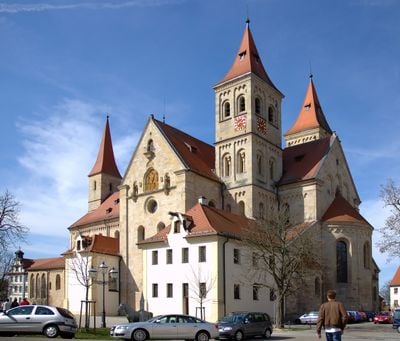
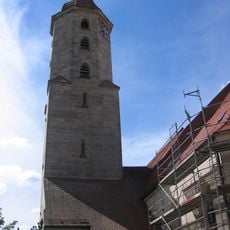
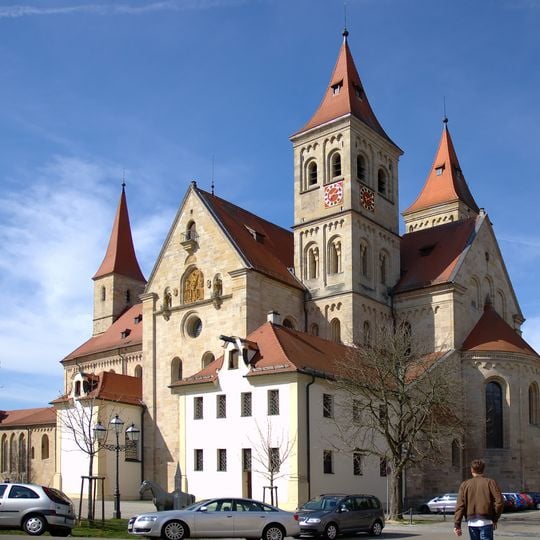
The Basilika St. Vitus is a late Romanesque vaulted basilica built from 1182 to 1233, with pale beige walls and red-tiled roofs. Two towers rise 42 meters on the east side, and a third sits as a roof turret on the west end of the 73-meter-long church. The gabled entrance section has an arched portal with sculpture and a circular window above.
The monastery was founded in 764 by Bishop Hariolf and his brother Erlolf, while the current building was constructed between 1182 and 1233. This made it a regional religious center for centuries to come.
The church holds relics of the 16 collegiate saints, including Sulpitius and Servilianus, patrons of the early monastery church. The shrine with the relics of the canonized founders Hariolf and Erlolf also stands in the basilica. The interior was redecorated in early Rococo style between 1637 and 1741 by Italian architects and sculptors Donato Riccardo Retti, Carlo Carlone and Emanuello Pignini, invited from Ludwigsburg.
Visitors can explore the western hall and Michael's Chapel, with guided tours sometimes available. The crypt beneath the church houses artworks and offers a quiet space to examine.
During the 1959–1964 restoration, excavations uncovered the so-called Ellwangen reliquary, a jewel casket attributed to Richilde of Provence. The Romanesque crypt was also reopened in the same campaign. The find is not on display in the church itself.
The community of curious travelers
AroundUs brings together thousands of curated places, local tips, and hidden gems, enriched daily by 92,882 contributors worldwide.