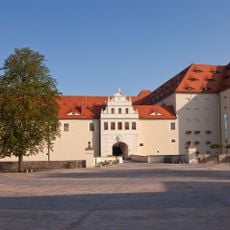
Freudenstein Castle, Renaissance castle in Freiberg, Germany
Freudenstein Castle is a four-winged Renaissance castle at the edge of Freiberg's old town, made up of several connected sections including the Long House, the New House, the Church Wing, and a number of towers. The buildings are arranged around a central courtyard, giving the complex a clear and enclosed shape.
A first fortress was built here in 1168 by Margrave Otto II of Meissen to guard the silver mines in the area. The current building was completed in 1577, when the old defensive structure was transformed into a residence for the Saxon rulers.
The Long House holds the terra mineralia exhibition, a private Swiss collection of about 80,000 mineral specimens, most of them cabinet pieces, shown on roughly 1,500 m². It came to the TU Bergakademie Freiberg in 2004 as a permanent loan from the Pohl-Ströher Mineral Foundation, set up by Erika Pohl-Ströher. The Church Wing houses the Freiberg Mining Archive, which keeps records of Saxon and German mining history from the 15th century onward: about 4,600 metres of files and 106,000 maps.
The castle sits at the edge of the old town and can be reached on foot from the center of Freiberg. The historic rooms have uneven floors and narrow staircases, so visitors with limited mobility should keep that in mind when planning their time.
The stump of a Romanesque round tower lies about 30–40 cm below the courtyard surface, in front of the Long House; its outline and the old castle ground plan are marked in the paving. Under the Long House and the Church Wing, two large Gothic cellar barrels survive. The staircase of the Long House is documented as the first straight-flight staircase in Saxony.
The community of curious travelers
AroundUs brings together thousands of curated places, local tips, and hidden gems, enriched daily by 92,854 contributors worldwide.