Static War Headquarters Castlegate, NATO command bunker in Linnich, Germany
Static War Headquarters Castlegate is an underground military command center built with concrete construction. The facility contains multiple levels designed to house operational functions and support systems for continuous command operations.
Plans for a secure NATO command post date to the early 1960s, when a bunker for two staffs was designed in Mönchengladbach. Construction at the Moolberg near Glimbach began in 1983 and was completed in 1992. After a NATO command restructuring the site lay idle until 1998, when it was rediscovered and refitted; it was handed over to NATO on 1 October 2001.
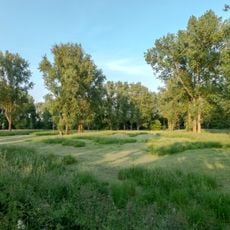
The bunker's name comes from its Cold War role as a "secure castle" for NATO staffs. In the 1980s the construction site drew peace-movement protests, and in 1986 around 1,200 people, among them Robert Jungk, Petra Kelly and Antje Vollmer, bought shares in an adjacent "Peace Field" to block further expansion. Buddhist monks later built a peace pagoda nearby.
The bunker lies about 2 km north-east of Linnich, on the southern edge of Glimbach on the Moolberg. It is a closed military site in caretaker status, run by a German contingent for NATO, and there is no visitor access. The complex reaches 28 m underground across six floors.
The bunker's 14,000 square metres are split into six underground floors reaching 28 metres deep, with 22.5 million euros of the roughly 85 million euro cost spent on electronics alone. In 1986, around 1,200 people bought shares in the neighbouring "Peace Field" to block any expansion of the site; shareholders included Petra Kelly, Walter Jens and Robert Jungk.
The community of curious travelers
AroundUs brings together thousands of curated places, local tips, and hidden gems, enriched daily by 94,256 contributors worldwide.