Cathedral of the Resurrection, Byzantine church building in Wilmersdorf, Germany.
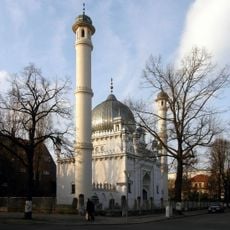
The Cathedral of the Resurrection is a five-domed Russian Orthodox cathedral on Hohenzollerndamm in Berlin-Wilmersdorf, built 1936–1938 by Karl Schellberg to a design by Sergei Schostowski. Its light plastered walls are divided by pilasters and pierced by tall round-arched windows; the central cube is crowned by a helmet-shaped dome in dark copper, with four smaller onion domes in the roof corners. A two-tier carved dark oak iconostasis, sent from Warsaw, stands inside.
The cathedral was built in 1938 and represents the religious diversity of Berlin at that time. It emerged as an expression of the growing Orthodox community's presence in the city during the interwar period.
Since 1951, services have been held in German alongside Church Slavonic. The two-tier iconostasis came from Warsaw, sent by Metropolitan Dionysius of the Polish Orthodox Church; it was originally in a garrison church in Mińsk Mazowiecki. The walls are plastered but unpainted, and the dark oak iconostasis holds only four icons on its lower tier, painted on a gold ground.
The cathedral stands on Hoffmann-von-Fallersleben-Platz at Hohenzollerndamm 166 in Wilmersdorf, on a slight rise at the edge of the square. Services have been held in Church Slavonic and German since 1951. The building itself belongs to the Berlin diocese of the Moscow Patriarchate since the 2011 purchase.
The two-tiered iconostasis came from Warsaw, sent by Metropolitan Dionysius (Waledyński) of the Polish Orthodox Church; it predates the revolution. The building itself has always belonged to the German state, which only sold it to the Moscow Patriarchate diocese in 2011. The concrete shell was erected over two years by the German builder Karl Schellberg.
The community of curious travelers
AroundUs brings together thousands of curated places, local tips, and hidden gems, enriched daily by 93,611 contributors worldwide.