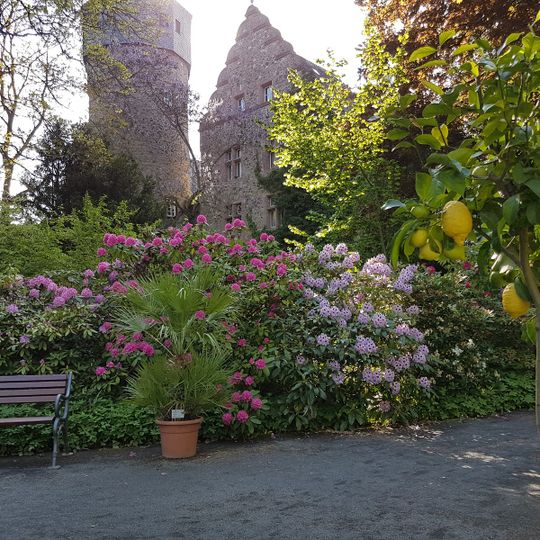
Botanischer Garten Gießen, Botanical garden in Giessen, Germany
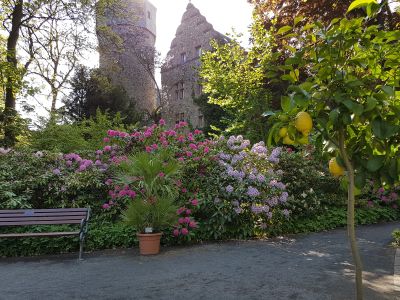
The Botanischer Garten Gießen covers about four hectares at the eastern edge of the former town rampart, whose remains lie under an artificial hill. Its old three-part layout of hortus medicus, first extensions and former forestry garden is still visible, and the entrance sits at the end of Sonnenstraße behind the Altes Schloss. Around 8,000 plant species are labelled mostly in German and Latin.
Landgrave Louis V founded the university in 1607 and gave it a garden in 1609; the physician Ludwig Jungermann laid out the hortus medicus on 1,200 m². The garden decayed during the Thirty Years' War, got a coldhouse in 1699 and its first glasshouse in 1720. In 1802 Friedrich Ludwig Walther added a forestry garden, and after 1805 the fortress wall was removed and its ground incorporated. Johann Bernhard Wilbrand merged the two gardens in 1826.
The garden connects closely with the University of Giessen, where students and researchers spend time observing plants and conducting studies. Visitors can see how the space functions as both a learning environment and a place where people engage directly with nature.
The entrance is at Senckenbergstraße 6, at the end of Sonnenstraße behind the Altes Schloss, so it is easy to miss. The garden is open daily and free of charge. The old three-part layout of hortus medicus, extension beds and former forestry garden can still be traced on the ground.
This garden holds the distinction of being Germany's oldest botanical garden still located at its original site. Few visitors realize that this place has preserved over 400 years of history in one continuous location.
The community of curious travelers
AroundUs brings together thousands of curated places, local tips, and hidden gems, enriched daily by 93,097 contributors worldwide.