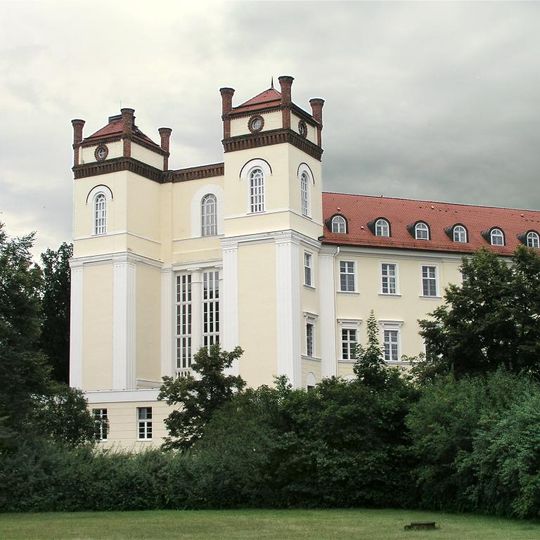
Schloss Lübbenau, Neoclassical château in Lübbenau, Germany.
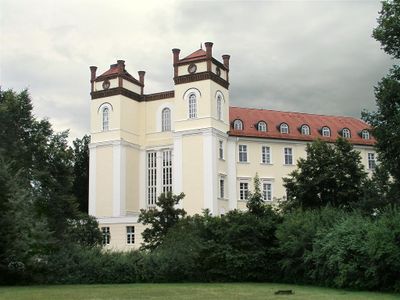
Schloss Lübbenau is a neoclassical building with cream-coloured walls and white pilasters. Two square towers with red-brown pyramidal roofs and tall arched windows rise at the rear; they were added in 1839. A long wing under a red tiled roof with dormer windows extends to the right, and the ground floor has smaller square windows. The building stands behind a hedge and trees.
A medieval water castle stood here before a Renaissance rebuilding around 1600. Carl August Benjamin Siegel gave the present Neoclassical form in 1817–1820, and Homann added the two rear towers in 1839. In 1944 conspirators around Claus Schenk Graf von Stauffenberg met here; owner Wilhelm Graf zu Lynar was executed at Plötzensee on 29 September 1944.
The park gate carries an iron tower and a crowned snake, the crest of the Counts zu Lynar, who came from Tuscany; Rochus Guerrini zu Lynar arrived in Germany in 1568. Widow Elisabeth zu Lynar bought the Lübbenau estate in 1621, and it stayed with the family over three hundred years. A museum opened in 1932 showed family portraits, Luther pamphlets and the armour of Count Johannes Siegesmund from the Thirty Years' War.
The castle now functions as a hotel and can be toured with a guide, with most areas remaining accessible to visitors. You should check opening times in advance, and parking is available on the grounds.
The park gate carries a wrought-iron tower with a crowned snake, the crest of the Counts zu Lynar, who came from Tuscany; Rochus Guerrini Count zu Lynar arrived in Germany in 1568. The family held Lübbenau from 1621 for over three hundred years, until the Nazis expropriated them in 1944.
The community of curious travelers
AroundUs brings together thousands of curated places, local tips, and hidden gems, enriched daily by 93,422 contributors worldwide.