Gentzrode, Moorish revival mansion in Neuruppin, Germany
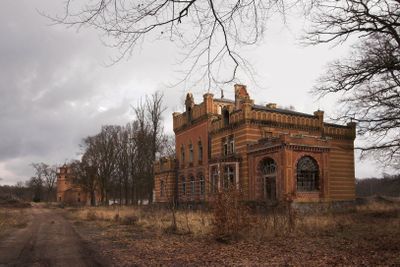
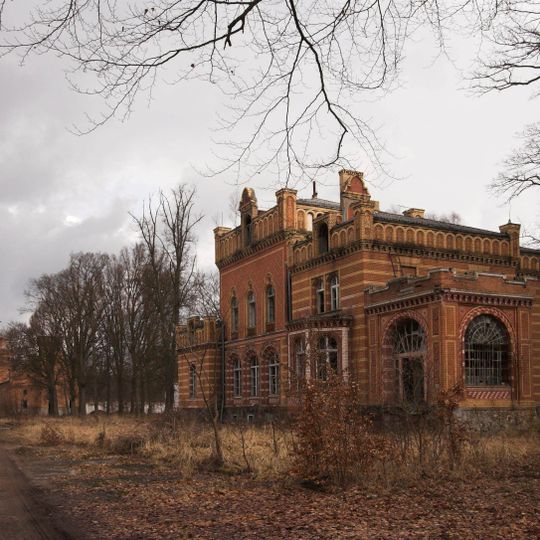
Gentzrode is a ruined red-brick estate north of Neuruppin, built from 1861 for Alexander Gentz. Its granary, designed by Carl von Diebitsch, stands beside a mansion of 1876/77 by Martin Gropius and Heino Schmieden. The brickwork carries lighter horizontal banding; the mansion's right section has a low domed roof and a projecting portico with a round-arched opening and a large semicircular traceried window, while the left section keeps a flat roofline with a raised central parapet and tall arched windows.
The mansion was built between 1876 and 1877 by architects Martin Gropius and Heino Schmieden. Financial difficulties arose shortly after completion due to the substantial construction expenses required for the project.
The name Gentzrode was requested by the Gentz family in December 1857 for their 2,756-Morgen estate, combining the family name with the German -rode for a clearing. The estate was laid out as a model agricultural operation, and its tree nurseries and park were assessed by specialists from across Germany; Berlin garden director Gustav Meyer judged them "gelungen" in 1873. Theodor Fontane visited in June 1864 for his Wanderungen durch die Mark Brandenburg and sketched the granary with its residential tower in his notebook.
The estate lies about 6 km north of Neuruppin, roughly 1.6 km west of the Tetzensee. The buildings are ruined and the grounds overgrown, so wear sturdy footwear. The site is privately owned; access is not guaranteed.
Theodor Fontane visited Gentzrode in June 1864 while researching the second edition of his Wanderungen durch die Mark Brandenburg and sketched the granary with its residential tower in his notebook. The granary itself was built between 1859 and 1862 to designs by Carl von Diebitsch.
The community of curious travelers
AroundUs brings together thousands of curated places, local tips, and hidden gems, enriched daily by 94,358 contributors worldwide.