Arnsburg Abbey, Cistercian monastery ruins in Lich, Germany
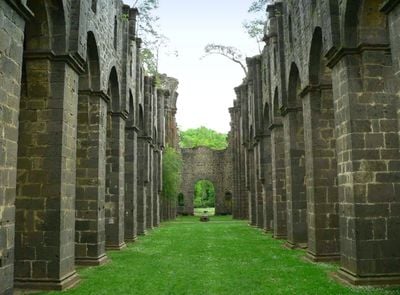
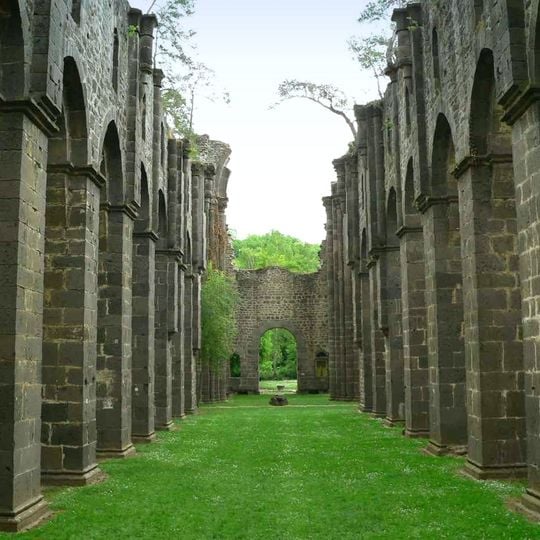
Arnsburg Abbey is a former Cistercian monastery whose roofless church ruin stands by the Wetter river. Two rows of tall pointed arches built from dark rectangular blocks with light mortar flank a grassy corridor and lead to a lower wall with a single rounded archway. The intact Baroque outbuildings are used by the Counts of Solms-Laubach.
A Benedictine monastery called Altenburg was set up here in 1150/51 by Konrad II and his wife Luitgard, but the monks from Siegburg made little progress and it was dissolved in 1174. That same year Kuno I von Münzenberg transferred the site to Eberbach Abbey for a Cistercian community, which arrived in 1197 under Abbot Mengot. The abbey was secularized in 1803 and the last monks left in 1810, after which the buildings passed to the Counts of Solms-Laubach.
The cemetery on the grounds honors people who died during World War II from different nations and camps. Visitors today see the names on the grave markers, which tell the story of those difficult years.
The grounds can be explored freely during daylight and offer a good overview of all the ruins from outside. A restaurant in the former mill building invites visitors to take a break and makes the visit more comfortable.
The abbey's Latin name, Monasterium Castrum Aquilae, translates as "Monastery of the Eagle's Fort." By the 15th century the monks rendered Arnsburg this way, linking it to the Roman eagle standard and the heraldic eagle used by Kuno of Arnsburg after serving two German emperors.
The community of curious travelers
AroundUs brings together thousands of curated places, local tips, and hidden gems, enriched daily by 92,844 contributors worldwide.