Castle Dyck, Moated castle in Jüchen, Germany
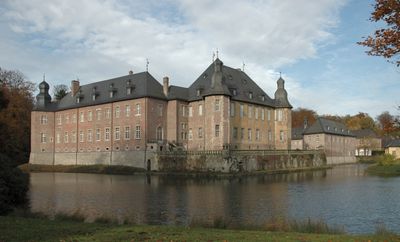
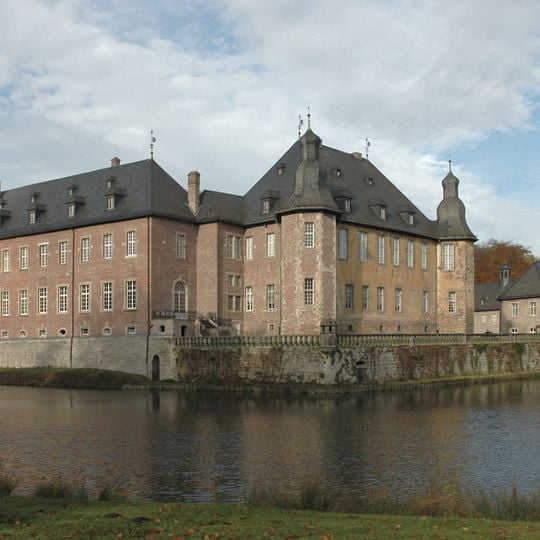
Castle Dyck is a moated castle in Jüchen whose main house, two forecourts and outbuildings stand on four islands within a triple moat system. The four-winged manor house, built 1636–1663 and bounded by corner towers, encloses an almost square courtyard. A brick wing with rows of multi-paned windows, a steep-roofed central section with a corner turret and a domed end tower rise above a balustraded stone wall.
A record of 1094 names Hermannus de Dicco as lord of a fortification here. In 1383 Cologne and Aachen troops, with the Archbishop of Cologne and the Duke of Jülich, besieged it and forced Gerhard von Dyck to demolish the high castle, rebuilt ten years later. After 1394 the Reifferscheid family inherited; Ernst Salentin had the residence rebuilt from 1658, and the south wing gained a staircase around 1897.
The castle has been run since 1999 by the Stiftung Schloss Dyck, a foundation for garden art and landscape culture, which grew out of the garden festival held here in 2002. Prince Joseph zu Salm-Reifferscheidt-Dyck, who laid out the park from 1794, wrote the botanical work Hortus Dyckensis cataloguing the plants grown here. The park is named a protected monument for its many valuable trees and plant rarities.
The grounds are accessible daily and can be explored on your own or with guided tours. Plan time for crossing bridges and viewing the water areas, especially if you want to see the gardens thoroughly.
Schloss Dyck Classic Days, launched in 2006, is a vintage car festival held in the castle park, not on a racetrack; its proceeds go toward maintaining the castle. The 2002 North Rhine-Westphalia state horticultural show also left new theme gardens on 24 hectares of former farmland, the Dycker Feld, which won the German Landscape Architecture Prize in 2003.
The community of curious travelers
AroundUs brings together thousands of curated places, local tips, and hidden gems, enriched daily by 92,883 contributors worldwide.