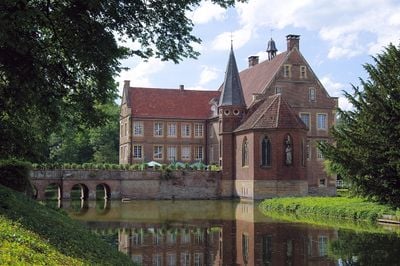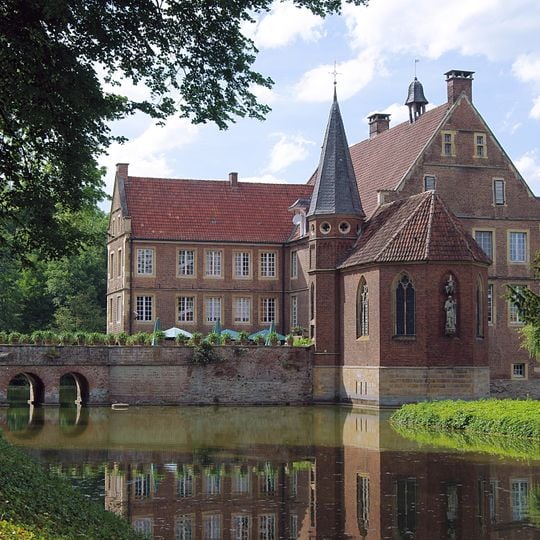
Burg Hülshoff, Renaissance water castle in Havixbeck, North Rhine-Westphalia, Germany
Burg Hülshoff is a water castle on two islands linked by a bridge, with red-brick walls and light stone trim. Its main wing has two storeys of tall windows and a hipped roof; a square tower with a steep pyramidal roof and finial rises to the right, beside a polygonal corner turret and a lower octagonal chapel-like wing with arched windows and a stone figure in a niche.
Burg Hülshoff was first mentioned in the 11th century as the Oberhof "Hoff von Hulshove". In 1417, Johann IV. Droste zu Hülshoff purchased the estate, and it remained in the family until 2012. Heinrich I. von Droste zu Hülshoff moved his main residence here after the Anabaptist rule in Münster. The castle was never conquered and served as a family seat for nearly 600 years.
Annette von Droste-Hülshoff was born at Burg Hülshoff in 1797 and lived here until 1826. Her sister Jenny's diary records the family's daily life, and the castle's library, chapel and portrait gallery, including a portrait of Annette, reflect the household of the Droste zu Hülshoff family, many of whom were mayors of Münster, jurists, writers and composers.
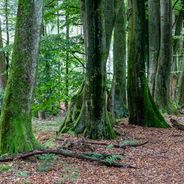
The castle park is open year-round with walking paths around the building and waterways. A restaurant in the vaulted cellar operates from April to November and offers seating in the inner courtyard during warmer months.
The castle was never conquered in six centuries as a family seat, though it had to lodge troops repeatedly: Prince-Bishop Christoph Bernhard von Galen seized it during his third siege of Münster, and the French commander Louis de Conflans during the Seven Years' War. In 1675, 105 people lived and worked here.
The community of curious travelers
AroundUs brings together thousands of curated places, local tips, and hidden gems, enriched daily by 92,890 contributors worldwide.