Steinfeld Abbey, Premonstratensian monastery in Kall, Germany
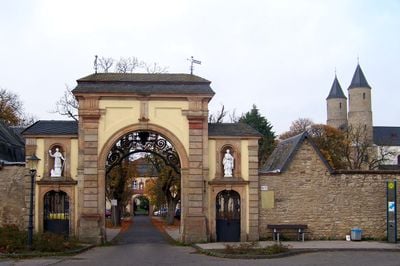
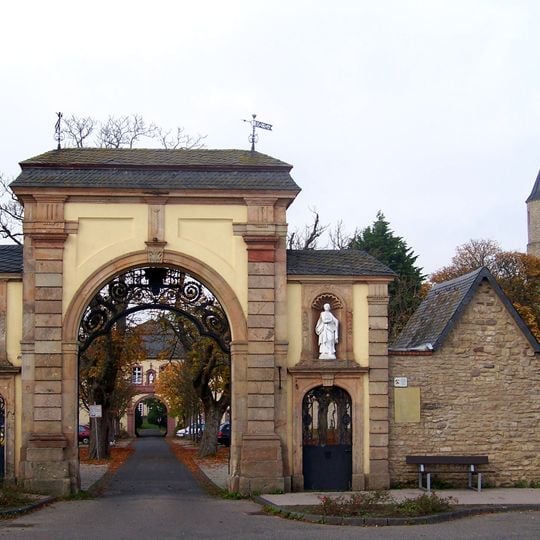
Steinfeld Abbey is a monastery complex where a basilica with eight bays forms the central structure. The building displays Romanesque, Gothic, Renaissance, and Baroque features, with six chapels integrated into the overall layout.
The site began as a settlement and became a monastery in 1070, later transforming into a Premonstratensian community in 1130. It attained abbey status in 1184.
The abbey church is dedicated to Saint Potentinus and his sons Felicius and Simplicius; their 13th-century shrine is kept today in the Louvre in Paris. Pilgrims leave fresh apples by the alabaster figure on Hermann Joseph's tomb, recalling the legend that he offered an apple to the Christ Child in Cologne, who accepted it.
The complex now includes a school, yet the basilica remains open for visitors to explore. You can walk through the grounds and observe the building's multiple architectural styles and periods at your own pace.
The Gothic cloister's stained glass, made between 1526 and 1557 by Gerhard Remisch, was sold after the 1802 dissolution to a dealer who shipped it to England. Most panels reached Lord Brownlow's collection at Ashridge Park and were later bought by the Victoria and Albert Museum; two are back in Steinfeld. M. R. James catalogued the glass at Ashridge and based his ghost story "The Treasure of Abbot Thomas" on it.
The community of curious travelers
AroundUs brings together thousands of curated places, local tips, and hidden gems, enriched daily by 93,070 contributors worldwide.