Birkeneck, Architectural heritage monument in Hallbergmoos, Germany.
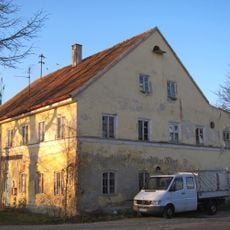
Birkeneck is a former prince-bishop's hunting lodge built in 1706 by Johann Franz Eckher von Kapfing und Liechteneck, Prince-Bishop of Freising. The complex in the northeast of Hallbergmoos, within sight of Munich Airport, consists of the castle building with its associated Baroque gardens and today houses the Jugendwerk Birkeneck, a residential youth welfare institution with around 100 places.
Birkeneck Castle was built in 1706 as a hunting lodge by Johann Franz Eckher von Kapfing und Liechteneck, Prince-Bishop of Freising. After secularisation in 1803 it changed hands several times and in 1826 passed to Theodor von Hallberg-Broich, founder of Hallbergmoos. In 1925 the Herz-Jesu-Missionare bought it to set up a home for at-risk youths, which still operates today with about 100 places. The site is listed as a monument under file number D-1-78-130-4.
The name Birkeneck combines "Birke" (birch) with "Eck" (corner or ridge). Since 1925 the former hunting lodge has housed the Jugendwerk Birkeneck, run by the Herz-Jesu-Missionare, offering around 100 places in residential, day-care and outpatient support for young people who cannot manage their situation without professional help.
Birkeneck lies in the northeast of Hallbergmoos on the road linking Hallbergmoos with Oberding, within sight of Munich Airport. The site is a youth welfare facility, so the grounds are not open to the public; the listed building and its baroque garden remains are best viewed from the connecting road.
Birkeneck's grounds are also listed as a buried monument: the Bavarian atlas records "subsurface early modern remains in the area of the former prince-bishop's hunting lodge with associated Baroque gardens" under file number D-1-7636-0202. The lodge itself appears in the monument list as D-1-78-130-4.
The community of curious travelers
AroundUs brings together thousands of curated places, local tips, and hidden gems, enriched daily by 93,648 contributors worldwide.