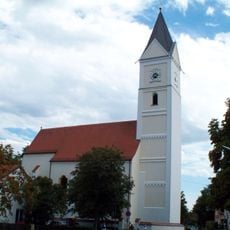
Schloss Erching, Castle with moat in Hallbergmoos, Germany
Schloss Erching is a three-story castle in Hallbergmoos situated on a circular island and surrounded by a water-filled moat. The water around the island varies in width and creates a natural barrier that separates the main structure from the surrounding grounds.
The construction of the castle was commissioned in 1652 by Bishop Albert Sigismund, who intended it as a hunting lodge. The estate remained under ecclesiastical control until 1802, when it passed into secular hands.
The chapel, dedicated to St. Walburga, was reconsecrated in 1672 and has a polygonal east tower topped by a welsche Haube, a bell-shaped roof typical of South German Baroque. Its ceiling and wall paintings are attributed to Johann Georg Kogler of Altenerding and date from around 1744; the altarpiece is from 1672.
The property operates today as a private residence and can be viewed from outside, though visitors should maintain distance and respect access restrictions. It is best to observe the structure and surroundings from public areas.
In 1829, Joseph von Utzschneider transformed the estate into an experimental agricultural operation where potatoes and beets were grown. This early facility was equipped with an integrated sugar factory that processed the farm production.
The community of curious travelers
AroundUs brings together thousands of curated places, local tips, and hidden gems, enriched daily by 92,784 contributors worldwide.